
The best time to start your dental practice financing pre-approval is before you make an offer on any practice, and ideally before you start seriously looking. You can often secure pre-approval in as little as two weeks, while the acquisition itself typically takes three to six months. Starting early means financing won’t hold up your deal.
For many dentists, buying a practice is the largest financial decision of their career. It is tempting to start with the exciting part: touring offices, reviewing listings, and imagining your name on the door. But the buyers who close smoothly are usually the ones who did their financial homework first.
This guide explains how dental practice financing works, when to begin the pre-approval process, the red flags that most often slow buyers down, and the documents you should have ready before you ever call a lender.
The Two Components of Dental Practice Financing
Securing a dental practice acquisition loan depends on two separate approvals: you have to qualify, and the practice has to qualify. Understanding the difference helps you see why pre-approval is something you can, and should, tackle on your own timeline.
1. You qualify as a borrower
Lenders first evaluate you personally. They review your clinical production history, income, creditworthiness, and overall financial standing. This part of the process is entirely about you, so you can complete it before you identify a specific practice.
2. The practice qualifies for the loan
Once you have a practice in mind, the lender evaluates the business itself. They review its financial performance, profitability, and ability to support the proposed debt. This step can only happen after you find a practice and gather its financial records.
Because the second step depends on a specific deal, it naturally happens later. The first step does not. Getting your personal pre-approval done early removes one of the biggest variables from the transaction before the clock starts ticking.
How Far in Advance Should You Start the Pre-Approval Process?
Start your pre-approval before you submit an offer to any seller. Since pre-approval can often be secured in as little as two weeks, there is little reason to wait, and real cost if you do.
A dental practice acquisition typically takes three to six months from start to finish. Securing your personal financing pre-approval early in that window helps you:
- Streamline the transaction. Your personal qualification is already done, so the lender can focus on the practice once you find one.
- Reduce potential delays. Issues with credit, debt, or documentation surface early, while you still have time to fix them.
- Show sellers you are serious. A pre-approval letter proves you are a financially qualified buyer, not just someone browsing.
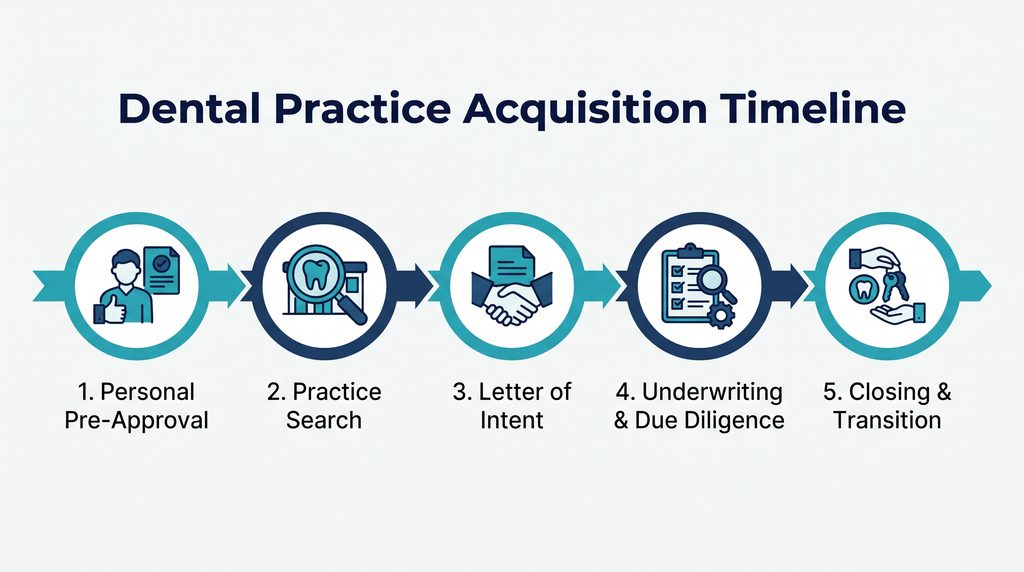
A practical sequence looks like this:
- Gather your personal financial documents.
- Apply for pre-approval with a lender experienced in dental practice loans (often about two weeks).
- Search for and evaluate practices with your pre-approval in hand.
- Submit an offer backed by your pre-approval letter.
- Complete practice-level underwriting, due diligence, and closing.
Common Red Flags That Delay Pre-Approval (and How to Avoid Them)
Most pre-approval delays come from four issues: limited production history, low liquidity, too much existing debt, and a credit score below 700. Each one is easier to fix months before an offer than days before a deadline.
Limited production history
Most banks want at least two years of production history to prove clinical competence. When you are acquiring a practice, they also want evidence that your production is sufficient to meet the demands of the specific practice you are buying.
How to avoid it: Track your production as an associate and request a Production by Provider report from your current employer. If you are early in your career, consider whether a smaller practice, or a little more time building your track record, is a better fit.
Insufficient liquidity
A down payment is almost never required for a dental practice acquisition. However, banks typically want you to hold about 10% of the loan value in personal liquidity, meaning cash and stocks. Balances in a 401(k) or Roth IRA do not count toward liquidity.
For example, a $1,000,000 acquisition loan would typically call for roughly $100,000 in cash and stocks.
How to avoid it: Start building liquid savings well before you plan to buy, and avoid tying up cash in large purchases during your search.
Excessive debt
Banks generally require a Debt Service Coverage Ratio (DSCR) of at least 1.2x. That means for every $1.00 in annual debt obligations, lenders want to see at least $1.20 in income available to service that debt.
Lenders consider your existing personal debts, including student loans, car loans, and mortgages, alongside the proposed practice loan. If your combined annual debt payments total $100,000, the bank would generally want to see at least $120,000 in annual cash flow available for debt service.
How to avoid it: Pay down balances where you can, and hold off on taking on new debt, such as a new car or a bigger home, while you prepare to buy.
Credit score below 700
A credit score below 700 can slow or complicate your pre-approval.
How to avoid it: Paying down credit card debt and loan balances is one of the quickest ways to improve your score. Check your credit report early so you have time to correct errors and lower your balances.
Documents to Gather Before Contacting a Lender
Having four core documents ready before your first lender conversation is the simplest way to keep pre-approval on the two-week track:
- Production by Provider report from your current employer, to prove your clinical track record.
- Your latest W-2, to verify income.
- A list of all current debt obligations, including student loans, car loans, mortgages, and credit cards, with balances and monthly payments.
- Recent bank statements to verify liquidity and cash balances. Remember that 401(k) and Roth IRA balances do not count toward liquidity.
Your lender may ask for more, but bringing these four items shows you are organized and ready to move.
How Long Does Dental Practice Loan Pre-Approval Last?
Pre-approval is not permanent, so confirm its validity with your lender every 60 to 90 days. Your pre-approval reflects your finances at a moment in time, and a practice search can take longer than expected.
Changes to the factors lenders care about, such as your income, debt load, liquidity, or credit score, can affect your standing. Keep your finances steady during your search, and check in with your lender regularly so your pre-approval is current when the right practice comes along.
Why Pre-Approved Buyers Win Competitive Listings
In a competitive market, pre-approval can decide which buyer gets the practice. For desirable listings, sellers will typically ask for evidence of financing pre-approval before accepting an offer and agreeing to a period of exclusivity.
Picture two dentists interested in the same well-run practice. The first already has a pre-approval letter and submits an offer with it attached. The second loves the practice but has not started the financing process. The seller can move forward with the first buyer right away, while the second is still gathering documents and waiting on the bank.
Buyers who have completed their financial due diligence hold a distinct advantage. They demonstrate both financial readiness and a serious commitment to closing, which is exactly what a seller wants to see before taking their practice off the market.
Get Pre-Approved First, Then Find Your Practice
The smartest first step toward practice ownership is not touring offices; it is getting your financing pre-approval in place. It can take as little as two weeks, shorten a three-to-six-month acquisition, and put you ahead of buyers who wait.
At TransitionOne, we have guided more than 600 dental practice transitions across the Midwest, and we help buyers prepare for every stage of the process, from financing readiness to closing.
If you are thinking about buying a practice, schedule a complimentary discovery call or learn more about our Buyer Services.
Want to understand the full cost of your loan, beyond the purchase price? Read The True Cost of Financing a Dental Practice Acquisition.