
When first-time dental practice buyers think about cost, they think about one number: the purchase price. That’s the wrong number to start with.
If you’re financing a $1,000,000 dental practice acquisition, the sticker price is just the beginning. The real cost of ownership is determined by your loan term, your interest rate, your liquidity position, the financing tools you set up before day one, and the decisions made at the negotiating table that most buyers don’t even know exist.
Most dentists spend years building clinical skills. Very few spend an equivalent amount of time building financial literacy before their first acquisition. That gap is expensive.
This guide covers everything a first-time buyer needs to understand about financing a dental practice, from how loan structure affects total cost, to what lenders actually look for, to the working capital tool that most new owners overlook until they need it urgently.
The Long-Term Cost of Your Acquisition Loan
Most dental-specific lenders offer 100% financing on practice acquisitions, with loan terms ranging from 10 to 15 years. Current conventional dental practice loan rates run between 7.0% and 9.5%, depending on lender, borrower profile, and market conditions at close. SBA 7(a) rates typically float at Prime plus 2.75% to 3.5%.
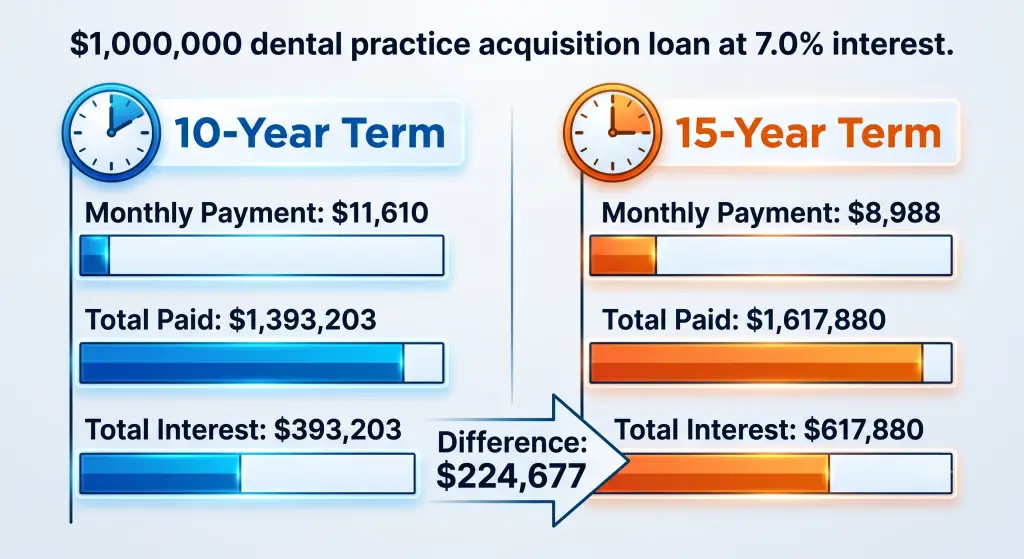
The term you choose has a far larger impact on total cost than most buyers realize. Here’s what the same $1,000,000 loan looks like across two common structures at a 7.0% rate:
| Loan Term | Interest Rate | Monthly Payment | Total Paid | Total Interest |
| 10 years | 7.0% | $11,610 | $1,393,203 | $393,203 |
| 15 years | 7.0% | $8,988 | $1,617,880 | $617,880 |
Choosing a 15-year term over a 10-year term at the same rate costs you $224,677 in additional interest over the life of the loan. That’s not a footnote. That’s a full-time associate’s annual salary paid to your lender in exchange for a lower monthly payment.
Does that mean a 10-year term is always right? No. The right term depends on your situation:
- Strong cash flow, minimal student debt: A 10-year term maximizes total savings. The higher monthly payment is manageable, and the interest savings are substantial
- Early career, significant student debt, or lower initial collections: A 15-year term may be necessary to keep the practice cash flow-positive in year one. The critical question is what you do with the monthly savings. If it goes into the business and generates a return above your loan rate, the longer term is a legitimate strategic choice. If it covers lifestyle expenses, it’s a deferred cost
The goal isn’t the lowest monthly payment. It’s the structure that fits your actual financial situation and serves your long-term wealth.
What Interest Rate Changes Actually Cost You
Rate negotiation is not a formality. Every 1% increase in your interest rate adds approximately $500 per month in interest costs on a $1,000,000 loan. Over a 10-year term, that’s roughly $60,000 in additional interest for a single percentage point.
Here’s a practical comparison across rate scenarios on a 10-year term:
| Interest Rate | Monthly Payment | Total Interest Paid | Difference vs. 7.0% |
| 7.0% | $11,610 | $393,203 | |
| 7.5% | $11,871 | $424,520 | +$31,317 |
| 8.0% | $12,133 | $455,979 | +$62,776 |
| 8.5% | $12,400 | $487,958 | +$94,755 |
| 9.0% | $12,668 | $520,143 | +$126,940 |
The difference between a 7.0% and a 9.0% rate on the same loan is nearly $127,000 in additional interest over 10 years. The difference between 7.0% and 7.5% is still $31,000. That number should motivate you to approach rate negotiation as seriously as you approach the purchase price itself.
Two practical implications:
- Fixed vs. variable: Fixed rates provide payment certainty over the life of the loan. Variable rates may be lower initially, but introduce risk if rates rise. For most acquisition loans, fixed is the more conservative and predictable choice
- Your credit profile directly affects your rate: A 720+ FICO score puts you in line for the best conventional dental lending rates. A score in the 680–720 range typically means a higher rate and sometimes more restrictive terms. Every percentage point of rate improvement from a stronger credit position is worth quantifying before you apply
What Lenders Look For
Even though you’re the borrower, dental practice acquisition underwriting primarily focuses on the business, not on you. Lenders want to confirm that the practice generates enough cash flow to service the debt and cover operating costs. Your personal profile establishes the floor; the practice’s economics determine the ceiling.
Credit Profile
Most dental-specific lenders require:
- Minimum FICO score: 680, with 720+ preferred for best rates and terms
- No major derogatory marks: Bankruptcies, defaults, or unresolved collections will either disqualify you or significantly raise your rate
- Clean credit history: Lenders treat your personal credit management as a signal for how you’ll manage business finances
If your score is below 720, address it before applying. Even a 6- to 12-month delay to improve your credit profile can save tens of thousands of dollars over the life of the loan.
Liquidity Requirements
Most lenders require $70,000 to $100,000 in verifiable liquid assets. This is frequently misunderstood. It is not a down payment requirement. The majority of dental practice acquisition loans are structured with zero money down. The liquidity requirement is a working-capital reserve signal: the lender needs to know you can cover a slow collections month, an equipment failure, or a short-term staffing gap without defaulting on the loan within the first 90 days.
If your liquidity falls below this threshold, your options are:
- Build cash reserves over 6 to 12 months before applying
- Negotiate seller financing for a portion of the purchase price to reduce the bank’s exposure
- Explore SBA 7(a) structures, which sometimes carry more flexible liquidity requirements
Debt Service Coverage Ratio (DSCR)
Most dental lenders require a minimum DSCR of 1.25, meaning the practice’s net operating income must cover annual debt service by at least 1.25 times. A practice generating $200,000 in net income with $140,000 in annual debt service has a DSCR of 1.43, which qualifies comfortably. If the practice’s cash flow is too thin relative to the loan payment, approval becomes difficult regardless of your credit score.
How to Compare Loan Proposals the Right Way
Not all dental practice loans are equal, and monthly payment is the wrong metric for comparison. Always secure at least two competing proposals before committing, and evaluate them across these dimensions:
- Total cost to completion: Principal + all interest + all fees over the full loan term. This is the only apples-to-apples comparison metric
- Interest rate type: Fixed vs. variable, and if variable, what index it’s tied to and how often it adjusts
- Prepayment flexibility: Some loans carry prepayment penalties of 1 to 5% of the remaining balance if you pay early. If you plan to accelerate payments, this is a significant term to negotiate
- Origination fees: Lenders commonly charge 0.5% to 2% upfront. On a $1M loan, 1% is $10,000 in the day-one cost factor. This should be factored into your true acquisition cost comparison
- Financial covenants: Some lenders impose performance covenants that require minimum revenue, maintenance of DSCR, or prior approval for capital expenditures. Understand what restrictions come with the loan before signing
- Working capital line availability: Some lenders offer combined acquisition loan and LOC packages. Consolidating your banking relationship can improve terms on both
Build a simple spreadsheet with the total cost to completion for each proposal. The proposal with the lowest monthly payment is often not the one with the lowest total cost. The one with the lowest total cost, the most favorable prepayment flexibility, and the fewest restrictive covenants is usually the right choice.
Conventional Bank Financing vs. SBA 7(a) Loans
Most first-time buyers have two primary paths: a conventional dental-specific bank loan or an SBA 7(a) loan. Understanding the tradeoffs before you apply saves time, money, and surprises at the closing table.
| Feature | Conventional Dental Loan | SBA 7(a) Loan |
| Down payment | Often 0% for qualified buyers | Typically 10–20% for loans over $500K |
| Interest rate | 7.0–9.5% (fixed or variable) | Prime + 2.75–3.5% (often higher than conventional) |
| Loan term | 10–15 years typical | Up to 10 years (working capital); up to 25 years (real estate) |
| Approval speed | 2–4 weeks for qualified borrowers | 30–90 days |
| Documentation | Standard financial package | Extensive: business plan, projections, SBA forms |
| Credit flexibility | Stricter; favors strong profiles | More flexible; government guarantee reduces lender risk |
| Goodwill financing | Yes, for dental-specific lenders | Yes, explicitly permitted |
| Personal guarantee | Typically required | Required for all owners with 20%+ equity |
| Best for | Well-qualified buyers with strong credit and liquidity | Buyers with thinner credit history, higher student debt, or a need for longer amortization |
The practical rule: If you qualify for conventional dental-specific financing, it usually offers a faster close, lower total cost, and fewer documentation requirements. If your credit profile or liquidity position makes conventional approval difficult, an SBA 7(a) loan is a legitimate and well-structured path to ownership, not a fallback. It’s a purpose-built tool for exactly this situation.
Notable dental-specific lenders active in 2026 include Bank of America Practice Solutions, Live Oak Bank, TD Bank Healthcare Practice Finance, Provide (Fifth Third), and PNC Healthcare. Each has different underwriting criteria and rate structures. Shopping across at least two is standard practice.
Seller Financing: When and Why It Makes Sense
Seller financing occurs when the seller loans a portion of the purchase price directly to the buyer, typically 10% to 20%, while a conventional lender funds the remainder. It’s not a fallback. In many transactions, seller financing is a strategic deal structure that benefits both parties.
For buyers, seller financing:
- Reduces the bank’s exposure, which can lower the rate you’re offered on the primary loan and make approval easier
- Signals seller confidence in the ongoing value of the practice; a seller who takes back a note believes the practice will perform under new ownership
- Preserves more of your liquidity at close for working capital rather than directing it toward a down payment
- Can accelerate closing on transactions where the buyer’s profile makes full conventional financing borderline
For sellers, seller financing typically provides favorable capital gains treatment on the deferred portion of the purchase price and demonstrates commitment to a smooth transition.
The seller financing note is documented as a separate subordinate obligation from the primary bank loan, with a defined interest rate, term, and repayment schedule. Your acquisition attorney handles the structuring. The key point for buyers is that seller financing is a legitimate deal tool, not a signal that the practice or seller is distressed.
The Working Capital Line of Credit: The Tool Most Buyers Miss
Of everything in this guide, the working capital line of credit is the element most commonly absent from a first-time buyer’s financing plan, and the one most likely to cause a crisis in the first 90 days of ownership.
How Dental Practice Cash Flow Actually Works
A dental practice’s revenue cycle is not a paycheck. It is a pipeline with a built-in delay. Most practices carry 30 to 45 days of accounts receivable at any given time. Insurance-heavy practices can extend to 60 days or more before collections land. That means:
- You deliver clinical care on day one
- You submit claims on day two
- Insurance processes and pays in 30 to 60 days
- Payroll, lab bills, and supply invoices are due now
Even a healthy, profitable practice has this structural cash timing gap. It doesn’t mean the practice is struggling. It means cash flow works differently here than it does in most other businesses. New owners who aren’t prepared for this dynamic can find themselves unable to make payroll in week three despite a full schedule and a profitable P&L.
What a Working Capital Line of Credit Does
A working capital line of credit (LOC) is a revolving credit facility, typically $50,000 to $150,000, that functions like a low-interest business credit card with a reset feature:
- Draw only what you need: use it for payroll, lab costs, supply orders, or any short-term operational gap
- Pay interest only on what you draw: a $100,000 LOC with $20,000 drawn costs you interest on $20,000, not $100,000
- Repay and redraw as collections arrive: as insurance reimbursements and patient payments come in, you pay down the balance and free up the line for the next cycle
The LOC doesn’t replace operating cash flow. It bridges the timing gap between when care is delivered and when revenue is collected, so you’re never short on cash despite being revenue-positive on paper.
Three Reasons to Set It Up Before You Need It
The working capital LOC serves three purposes beyond bridging the A/R gap:
- Liquidity preservation: Your $70,000 to $100,000 in liquid reserves stays liquid, held in reserve for genuine emergencies rather than being drawn down by routine operational cycles in month one
- Business credit building: A well-managed revolving LOC establishes your business credit profile, which matters when you need equipment financing, expansion capital, or a second location down the road
- Strategic flexibility: When a marketing opportunity, equipment upgrade, or hiring decision appears in year one, you have capital available without disrupting operations
The right time to apply for a working capital line of credit is during the acquisition process, not after closing. Lenders approve credit based on stable cash flow. In the first 30 to 60 days of new ownership, cash flow looks uncertain on paper. Establish the LOC while the prior owner’s financials remain the anchor of the application.
Your Financing Decision Framework
Before you submit a single loan application, answer these questions honestly:
- What is my FICO score, and what rate does it qualify me for? If it’s below 720, what would a 6-month improvement do to my total loan cost?
- Does my liquid position meet the $70,000 to $100,000 threshold? If not, what is the realistic timeline to get there, and does it make sense to wait?
- Does the practice’s DSCR support the loan at the term I’m considering? Have I verified cash flow using three to five years of tax returns, not just the broker’s stated net income?
- Have I received at least two competing loan proposals and compared them on total cost, not monthly payment?
- Does conventional financing fit my profile, or should I explore SBA 7(a) as a primary path?
- Is seller financing on the table, and would it improve my terms or approval odds?
- Have I applied for a working capital LOC, or am I planning to apply during the acquisition process?
Every one of these decisions compounds. A stronger credit profile, a competitive rate comparison, and a working capital LOC established pre-close can easily represent $100,000 or more in combined first-year value relative to a buyer who approaches financing as an afterthought.
FAQs
What is the typical down payment for financing a dental practice?
Many dental-specific lenders offer 100% financing with zero down payment for qualified buyers. However, lenders typically require $70,000 to $100,000 in verifiable liquid assets as working capital reserves, which is separate from a down payment. SBA 7(a) loans generally require a 10 to 20% down payment for acquisitions over $500,000.
What interest rate should I expect on a dental practice acquisition loan in 2026?
Conventional dental practice acquisition loans currently range from 7.0% to 9.5%, depending on your credit profile, lender, and loan structure. SBA 7(a) rates are typically set at Prime plus 2.75% to 3.5%. Rates are negotiable, and a 1% difference on a $1M loan over 10 years represents approximately $60,000 in additional interest.
What credit score do I need to finance a dental practice acquisition?
Most lenders require a minimum FICO score of 680. A score of 720 or higher qualifies you for the best available rates and terms. Derogatory marks such as bankruptcies, defaults, or unresolved collections will either disqualify the application or significantly increase your rate.
Is a 10-year or 15-year loan term better for a dental practice acquisition?
A 10-year term at the same rate costs significantly less in total interest, roughly $224,000 less on a $1M loan at 7.0%. A 15-year term has a lower monthly payment, which improves early cash flow but comes at a substantial long-term cost. The right term depends on your income, student debt burden, and the practice’s cash flow relative to its debt service requirements.
What is the difference between a conventional dental loan and an SBA 7(a) loan?
A conventional dental-specific loan typically offers zero down payment for qualified buyers, faster approval (2–4 weeks), and lower total cost for well-qualified borrowers. An SBA 7(a) loan requires 10 to 20% down for larger loans, takes 30 to 90 days to close, involves more documentation, and typically carries slightly higher rates but offers more flexible underwriting for buyers with thinner credit histories or higher debt-to-income ratios. SBA 7(a) explicitly permits financing goodwill and working capital alongside the acquisition price.
What is seller financing in a dental practice acquisition?
Seller financing is when the seller loans the buyer a portion of the purchase price, typically 10 to 20%, while a conventional bank funds the remainder. It reduces the bank’s exposure, can improve approval odds and rates, preserves the buyer’s liquidity, and signals the seller’s confidence in the practice’s ongoing performance. It’s structured as a separate subordinate note by the acquisition attorney.
Why do I need a working capital line of credit when buying a dental practice?
Dental practices operate with a 30 to 60-day accounts receivable pipeline, meaning you deliver care today and collect revenue weeks later. A working capital line of credit bridges this timing gap so you can cover payroll, lab bills, and supplies while waiting for insurance reimbursements and patient payments. It should be established during the acquisition process before closing, while the prior owner’s financials support a clean application.
What is DSCR, and why does it matter for dental practice financing?
Debt Service Coverage Ratio (DSCR) measures how much of a practice’s net operating income is available to cover debt payments. Most dental lenders require a minimum DSCR of 1.25, meaning net income must be at least 1.25 times the annual debt service. A practice with insufficient cash flow relative to its purchase price and loan structure will face approval challenges regardless of the buyer’s credit score.
The Bottom Line
The purchase price of a dental practice is the number on the term sheet. It is not the number that determines whether ownership succeeds financially. The numbers that matter are your interest rate, your loan term, your DSCR, the fees buried in your loan proposal, and whether you have a working capital tool in place before your first payroll date.
Financing a $1,000,000 dental practice acquisition is a CEO-level decision. It deserves CEO-level analysis, not a signature on the first term sheet that arrives.