
Building multiple dental practices sounds like the pinnacle of dental entrepreneurship. More revenue, more reach, more enterprise value. The math looks compelling on the way up.
The math looks very different on the way out.
Dr. Dan, a dentist who built five profitable practices, spent two years trying to sell them. He worked with corporate buyers who changed the deal terms at closing. He worked with individual buyers who couldn’t arrange financing at the scale he needed. He held meetings, signed NDAs, shared financials, revised terms, and waited. And after two years of burning time and morale, he gave up the search entirely and settled back into the HR role he had been desperate to escape.
He was not the victim of a bad market. He was not the victim of bad timing. He was the victim of the wrong strategy for the wrong buyer, applied to the wrong type of asset.
This is the story most multi-practice dental owners never hear until they’re living it.
Why Building Multiple Practices Creates a Different Kind of Selling Problem
There is nothing wrong with building multiple dental practices. Many dentists do it successfully and build genuine enterprise value in the process. But the strategies that work for building a dental group work against you when it comes time to exit, if you apply the wrong framework.
A solo dental practice sale is a relatively contained transaction. One practice, one location, one patient base, one set of financials. The buyer pool is wide: any qualified dentist with sufficient clinical background and lender support can evaluate the opportunity. The market is mature and liquid.
A multi-practice group sale is an entirely different animal. The buyer pool narrows dramatically. The financial complexity increases. The operational diligence required expands from one set of books to five. The regulatory coordination multiplies. And the deal structure that works for a solo buyer, an SBA-financed individual with a letter of intent, is simply not designed to handle the transaction.
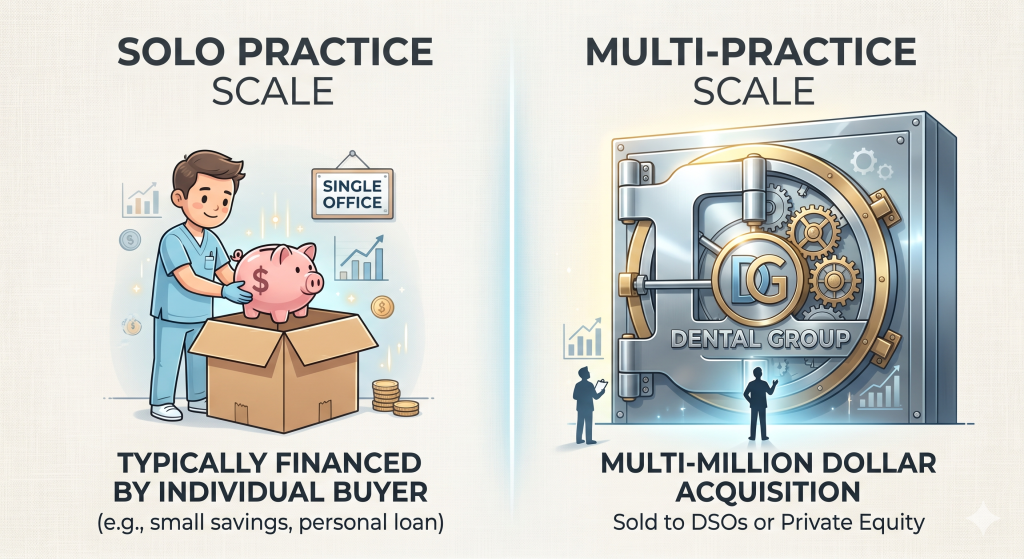
According to Private Practice Research’s 2026 dental practice ownership framework, multi-location group practices and large platform dental groups require different exit strategies, different buyer profiles, and different capital structures than solo practice sales. The seller who applies solo-practice sale logic to a multi-practice exit will encounter exactly what Dr. Dan encountered: buyers who can’t finance the deal, and institutional buyers who play a different game.
The Buyer Mismatch
The most common mistake multi-practice dental owners make when initiating a sale is testing the market with individual dentist buyers.
Individual buyers are qualified for solo and small-group practice acquisitions. They work within SBA 7(a) lending parameters, which have loan limits that effectively cap what a single dentist can borrow. The SBA’s small business loan program data confirms that SBA 7(a) loans are capped at $5 million, with most dental practice acquisitions financed well below that ceiling. A multi-practice group generating $5 million or more in annual collections, with an asking price in the range of $5 million to $8 million depending on the structure, is simply outside the financing capacity of most individual dentist buyers.
This is not a reflection of the buyers’ quality or commitment. It is a structural mismatch between what was built and what the individual buyer market can finance. A dentist who spends time introducing a $6 million multi-practice group to individual buyers is not just wasting time. They are burning through their window of peak value, allowing operational drag and staff uncertainty to accumulate while the right buyer type never arrives.
Why Corporate Buyers Change Terms at the Last Minute
Dr. Dan’s story includes a detail that resonates with almost every multi-practice seller who has tried to navigate a DSO transaction without expert representation: the corporate buyer who changed the terms at closing.
This is not an accident. It is a documented feature of certain corporate acquisition processes.
Private Practice Research’s DSO offer evaluation framework identifies term changes at or near closing as one of the highest-risk structural features of DSO transactions, particularly for sellers who have not run a competitive, multi-buyer process with professional representation. When a seller is locked into exclusive negotiations with a single DSO and has invested months of due diligence, attorney fees, and emotional energy into a deal, the DSO has significant leverage to renegotiate. The seller’s walk-away power diminishes with every week of exclusivity.
The mechanism is documented: headline offers contain earnout provisions with a 40% to 100% realization range, employment term requirements that reduce post-close income by 10% to 20% below market rate, and rollover equity components with 5 to 7-year liquidity horizons. When these components are adjusted at the final stages of negotiation, the headline price remains the same while the economic value to the seller decreases substantially.
The antidote is not avoiding DSO buyers. For a multi-practice group of Dan’s scale, institutional buyers are the right buyer type. The antidote is running a competitive, multi-buyer process with professional representation, so the seller maintains leverage throughout, and no single buyer can extract late-stage concessions without the risk of losing the deal to a competitor.
The Pricing Trap That Keeps Multi-Practice Sales Off the Market for Years
Multi-practice dental owners are not naive. They know their businesses are valuable. They have annual revenue figures, staff counts, and market positions that make the scale of what they built unmistakable. And that knowledge, combined with the emotional investment of a decade or more of building, can produce pricing expectations that are difficult to calibrate against market reality.
Peer-reviewed research on the emotional determinants of first-offer prices in SME sales found that small and medium business owners’ first-offer prices are systematically influenced by emotional factors, particularly pride of ownership, sunk cost investment, and identity attachment, that are independent of objective financial value. The research found that these emotional determinants reliably push first-offer prices above what market data supports, creating a valuation gap that slows or prevents transactions.
For a multi-practice dental owner, this dynamic is compounded by the complexity of the asset. Unlike a solo practice with straightforward comps, a five-location dental group has few identical comparisons in the private market. The seller has limited data to anchor their price against, making emotional anchoring more influential.
The consequence is the two-year delay Dan experienced. Not because his practices lacked value. Not because the market lacked interest. But because the price expectation was set before a qualified, experienced advisor analyzed the asset and aligned the structure with what institutional buyers in his specific market and collection tier were actually prepared to pay.
The Right Buyer for a Multi-Practice Group
Understanding the right buyer type is the most important strategic clarity a multi-practice dental owner can develop before initiating any sale process.
For a dental group with multiple locations, the buyer pool is almost exclusively institutional:
- Regional DSOs are building a network in specific geographic clusters and looking for acquisitions that give them scale in a market
- Private equity-backed platform practices seeking add-on acquisitions at EBITDA multiples that reflect group-level synergies rather than solo-practice comps
- National DSO groups with active acquisition pipelines targeting practices above a minimum EBITDA threshold
- Strategic acquirers, such as larger dental groups in the same market, are looking to expand their footprint and patient base
Precedence Research’s analysis of the U.S. DSO market confirms that the DSO sector was valued at $155.65 billion in 2025 and is projected to reach $302.54 billion by 2035. The capital flowing into this market is substantial and specifically targeting multi-location groups that offer geographic clustering, operational scalability, and strong EBITDA. A dentist with five profitable locations in a suburban cluster is exactly the profile that acquisition teams at major DSOs are actively seeking.
The challenge is not finding institutional interest. The challenge is navigating institutional buyers with the same discipline and leverage that institutional buyers bring to the table.
What 110% of Collections Actually Means
When an advisor with the right institutional buyer relationships sells a five-location dental group for 110% of annual collections, that outcome reflects several specific conditions that don’t happen by accident.
First, it reflects a competitive process. Private Practice Research’s marketed process analysis documents that practices sold through a structured, multi-buyer process achieve approximately 50% higher final transaction values than those sold through single-buyer, unsolicited offers. When two large, credible groups are competing for the same acquisition, neither can afford to lose on price alone. The competitive tension produced the premium.
Second, it reflects the right buyer type. Institutional buyers value multi-location dental groups at EBITDA multiples that reflect their platform synergies, not the collections-based formula used for solo practice sales. A group generating strong, documented EBITDA across five locations commands institutional pricing, not commodity pricing.
Third, it reflects documentation and positioning. The seller’s financials were clean, normalized across all five locations, and presented in a format that institutional due diligence teams could process efficiently. The Duckett Ladd dental M&A financial checklist identifies clean, multi-year, multi-location financial documentation as one of the primary drivers of premium pricing and deal certainty in group practice transactions. A buyer who can run efficient diligence submits a stronger, more confident offer.
The Human Cost of Staying Too Long
Behind the financial narrative of Dr. Dan’s story is a human one that deserves equal attention.
The dentist who built five practices did so at high personal cost. He took on the HR role for 34 staff members. He found himself unable to do the clinical work he loved because operational fires consumed his days. He became the administrator of a business that was supposed to fund his freedom, not replace his clinical joy with spreadsheets and staff disputes.
This pattern is documented. The GoTu State of Work 2026 survey of more than 7,900 dental professionals found that 54.1% reported experiencing burnout, with workload (65.7%) and cultural pressures (62.4%) as the primary drivers. For owner-operators of multi-location groups, the administrative burden compounds over time. The dentist who builds five practices to maximize income often finds, as Dan did, that the income is accompanied by an operational burden that no revenue figure fully compensates for.
This is the hidden cost of a delayed exit. Every month that Dan spent trapped in the wrong sale process was another month of an HR role he never wanted, managing staff dynamics that drained him, and carrying the weight of operational complexity that was supposed to have been someone else’s problem by now.
Time is not a renewable resource. A two-year delay in a multi-practice sale is not just a financial story. It is two years of life.
What Dr. Dan Teaches Every Ambitious Dental Owner
The lessons from Dan’s experience are not discouraging. They are clarifying.
The exit strategy must match the asset. A multi-practice group requires a multi-practice exit plan. The buyer types, deal structures, pricing frameworks, and advisor relationships appropriate for a solo practice sale are not appropriate for a group practice sale. If you have built something bigger, your exit plan must be correspondingly more sophisticated.
Institutional buyers require institutional preparation. The institutional buyer who pays 110% of collections needs five years of clean, consistent financials across all locations, a normalized EBITDA that survives due diligence, a staff and operational structure that demonstrates post-acquisition stability, and a transition plan that gives them confidence in the post-close performance they are paying for. That preparation does not happen in 90 days. It begins years before the listing.
The right advisor knows the right buyers before the process starts. The difference between two years of failure and a 180-day close was not market conditions. It was advisor relationships. An advisor who already has established relationships with credible institutional buyers, who knows which groups are actively acquiring in a specific geography, and who has completed similar transactions at a similar scale, can compress what would otherwise be a years-long search into a months-long process.
The right deal structure creates alignment, not resentment. Dan’s three-year employment obligation, with the ability to produce at $10,000 per day again, was not a constraint. It was an invitation back to the work he loved. The right deal structure, properly negotiated, aligns the seller’s interests with the buyer’s growth objectives in a way that makes the post-close period genuinely better than the pre-sale grind.

FAQs
What type of buyer is right for a multi-practice dental group?
Multi-practice dental groups are best matched with institutional buyers: regional DSOs, private equity-backed platform practices, or national DSO groups with active acquisition programs. Individual dentist buyers, whose financing is limited by SBA loan caps, are generally not appropriate for group practice transactions above $2 million to $3 million in asking price. Per Private Practice Research’s practice ownership framework, multi-location groups require different capital structures and buyer profiles than solo practice sales.
Why do DSO buyers sometimes change deal terms near closing?
Without competitive pressure from other qualified buyers, a DSO that has secured exclusivity has increasing leverage as the process extends. Private Practice Research’s DSO offer evaluation framework documents earnout realization rates ranging from 40% to 100%, employment term adjustments that reduce post-close income, and rollover equity provisions that can obscure the true economic value of a headline offer. Running a competitive, multi-buyer process with professional representation is the most reliable protection against late-stage term changes.
Can a multi-practice dental group sell for more than 100% of annual collections?
Yes, and this is more common than many sellers realize when the right buyer type is engaged through the right process. Institutional buyers value group practices on EBITDA multiples that reflect platform synergies, not the collections-based formula used for solo practices. Per Private Practice Research’s marketed process data, competitive processes with two or more qualified institutional buyers consistently produce premium outcomes.
Why do multi-practice dental owners sometimes spend years trying to sell without success?
The most common cause is a mismatch between the asset type and the buyer pool being approached. Testing a large group practice on individual dentist buyers who lack sufficient financing capacity, or engaging a single institutional buyer without competitive alternatives, produces exactly the two-year delay pattern documented in this article. An advisor with existing institutional buyer relationships and experience in group practice transactions can compress that timeline dramatically.
What does post-close employment look like after a group practice DSO sale?
Most DSO acquisitions include a post-close employment agreement of two to five years, during which the selling dentist continues to practice clinically. For a dentist who built a group primarily to escape clinical work, this structure requires careful negotiation. For a dentist who built a group to fund their freedom and still loves clinical work, the post-close employment can be an opportunity to return to hands-on dentistry at strong compensation while the administrative burden transfers to the acquiring organization. The structure should be negotiated to reflect the seller’s actual preferences.
How should a multi-practice owner prepare their group for sale?
Begin at least 24 to 36 months before the target closing date. Private Practice Research’s transition decision framework recommends normalizing EBITDA across all locations, resolving any operational dependencies on the owner, building associate-driven production systems, and assembling clean, CPA-reviewed financials for all locations for a minimum of three years. Documentation and operational independence are the two most important variables in institutional buyer interest and offer quality.
Conclusion
Bigger is not always better. Five practices are not five times the freedom of one. For many dental owners who build at scale, it is five times the operational complexity, five times the HR burden, and, if the exit is not planned correctly, five times the difficulty of getting out.
Dr. Dan’s story ends well because the right advisor was finally brought in, with the right relationships and the right institutional buyer contacts. Two credible groups competed for the same acquisition. The seller closed in 180 days for 110% of collections, returned to the clinical chair he loved, and deposited a check that reflected everything he had actually built.
That outcome was not luck. It was the result of applying the right strategy to the right asset with the right buyer profile.
If you have built something significant, your exit plan should be as ambitious as your growth plan was. The practices you built deserve a transition that captures their full value.