
Ask a young dentist how long they plan to practice, and the answer comes quickly. Twenty-five years. Thirty. Maybe more. They feel good. Their back doesn’t hurt yet. Their hands are steady. They have student loans to pay, a practice to build, a family to provide for, and decades of clinical work ahead.
That certainty is understandable. It is also one of the most financially dangerous assumptions a dentist can make.
The reality of the dental profession is that the decision of when you stop practicing dentistry is not always yours to make. Back injuries, wrist problems, neck degeneration, sudden illness, and family emergencies end dental careers early, and they do so without warning and without compassion for where you are in your savings plan.
This is not a pessimistic view of the profession. It is the view that every financially prepared dentist holds: plan for the realistic scenario, not the best-case one. Plan as if you have 5 to 10 productive years ahead, regardless of how many you believe you have, and let everything you build financially reflect that discipline.
The Illusion of the 25-Year Career
The average dental school graduate finishes with approximately $300,000 or more in student debt, according to ADA Health Policy Institute data on dental school debt and income trends. After completing school in their late 20s or early 30s, then spending two to four years as an associate before acquiring a practice, most dentists don’t reach full ownership until their mid-to-late 30s.
From that point, a 25-year career looks perfectly reasonable on paper. It puts retirement somewhere in the mid-60s, roughly aligned with conventional retirement planning, and provides time to build a patient base, pay down debt, and accumulate assets.
The problem is that paper doesn’t account for reality.
The ADA’s 2025 U.S. Dentist Workforce update reports that the average dentist retirement age in 2024 was 68.7 years, a figure that sounds reassuring until you consider that this average includes a significant tail of early retirements driven by health events, injury, and burnout, not voluntary, well-planned transitions. For every dentist who practices productively into their early 70s, there is another who is forced out of the chair a decade earlier than planned.
The 25-year career is a planning assumption, not a guarantee. And financial plans built on assumptions have a way of failing at precisely the wrong moment.
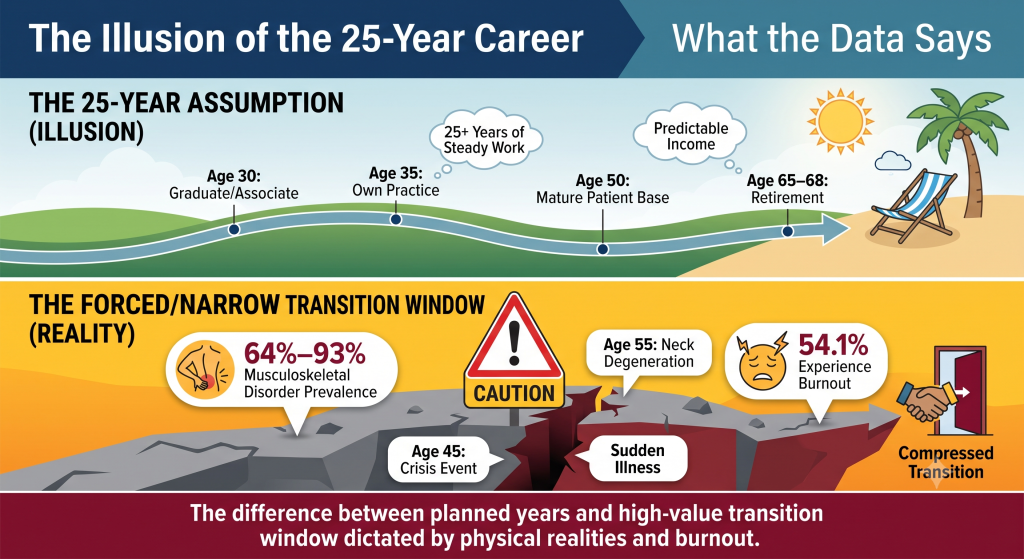
What the Data Says About When Dentists Actually Stop Working
The gap between when dentists plan to retire and when they actually do is a documented phenomenon, not a rare exception.
Private Practice Research’s 2026 State of U.S. Dental Practice Ownership framework notes that for dentists in the Senior Generation cohort (65 and older), planning succession by age 68 to 70 significantly improves transition outcomes, because the window to execute a value-maximizing sale becomes compressed beyond that point. Deferred-maintenance discounts, reduced patient engagement capacity, and declining lender appetite for older practices all converge to reduce what a late-planning seller can realistically achieve.
The same research identifies a concerning pattern: DSO affiliation pursued after age 72 to 74 yields substantially worse post-close terms than affiliation initiated between 65 and 68, simply because the leverage a well-run, actively managed practice commands erodes over time when the owner is no longer operating at full capacity.
The takeaway is not that dentists age out quickly. It is the ideal window for a high-value transition is narrower than most dentists believe, and it closes faster than they plan for.
The Physical Reality of Clinical Dentistry
Dentistry is one of the most physically demanding professional occupations. Extended periods of static posture, repetitive fine motor movements, and sustained awkward positioning create a predictable set of musculoskeletal vulnerabilities that accumulate across a career.
Research published in the Journal of Occupational Medicine and Toxicology on musculoskeletal disorders among dental professionals found that the prevalence of musculoskeletal disorders among dentists ranges from 64% to 93% across studies, with the neck, shoulder, lower back, and hands being the most commonly affected regions. The research identified that the demands of maintaining precision while sustaining awkward postures across a full clinical day create conditions where cumulative injury is nearly inevitable over a sufficiently long career.
The practical implication is not that every dentist will be disabled. It is that the body keeps score. Back injuries, rotator cuff problems, carpal tunnel, and cervical degeneration are occupational hazards of clinical dentistry, and they intensify with age. A dentist who plans as though their physical capacity is indefinitely sustainable is planning on the best-case scenario, not the realistic one.
The Career Shortener Nobody Sees Coming
Physical injury gets the most attention as a career-ending risk. Burnout is quieter, more gradual, and more common.
The GoTu State of Work 2026 report, which surveyed 7,914 dental professionals, found that 54.1% reported experiencing burnout, with approximately 80% of those who experience it doing so recurrently. The primary drivers were workload (cited by 65.7%) and workplace culture issues (62.4%). The report found that burnout was influencing major career decisions: 51.7% of burned-out professionals had changed practices, 49.3% had considered leaving the field entirely, and 43.4% had reduced their working hours.
Burnout doesn’t always end a career in a single dramatic event. More often, it compresses it. A dentist who planned for 25 productive years begins cutting back at year 15, working three days a week by year 18, and quietly stops taking new patients by year 20. The financial shortfall that is created, across five to seven years of reduced income and delayed practice-building, is significant and largely invisible until it shows up in a retirement savings gap.
The PMC research on career satisfaction and trajectory among dental professionals identifies that burnout-driven career compression is one of the most underestimated risks to long-term financial planning in the profession, and that the dentists most at risk are those who have not established financial independence early enough to exercise genuine career flexibility when burnout arrives.
What It Means to Plan for 5 to 10 Years
Planning for 5 to 10 productive years does not mean expecting your career to end in 5 to 10 years. It means building financial security at a pace that gives you choices regardless of what happens to your career.
The distinction matters enormously. A dentist who plans for 25 years:
- Saves at a comfortable rate that works if everything goes according to plan
- Delays building a formal exit strategy because it feels premature
- Relies heavily on the eventual practice sale as the capstone of their retirement funding
- Carries significant financial exposure in the years before that sale
A dentist who plans for 5 to 10 years:
- Saves aggressively in the early years of practice ownership, when compounding has the most impact
- Builds a formal financial plan and exit strategy in parallel with building the practice
- Reduces their dependence on the practice sale by accumulating wealth outside of practice equity
- Creates the financial conditions to stop practicing by choice, not necessity, at any point
The National State of Owner Readiness report found that 49% of private business owners want to exit their businesses within five years, but only approximately 20% have a formal written exit plan in place. The gap between exit intention and exit preparation is one of the most reliably documented patterns in small business ownership, and dental practices are no exception.
The Three Financial Foundations Every Dentist Needs
Financial security for a dentist is built on three distinct, non-negotiable foundations. All three must be established concurrently. None can substitute for the others.
1. Practice profitability and documented cash flow. The practice is your largest income generator and, eventually, your largest single liquid asset. Every year you operate the practice, its financial records are building toward either a compelling sale value or a disappointing one. Private Practice Research’s 2026 valuation framework confirms that the structured sale process that produces 50% higher transaction values than unsolicited offers requires clean, consistent financial records. Those records don’t materialize in the six months before a listing. They accumulate over the years.
2. Personal retirement savings independent of the practice. The practice sale should fund retirement generously, not barely. Every dentist should be contributing aggressively to tax-advantaged retirement accounts from the early years of practice ownership. Davies Wealth Management’s retirement planning guide for physicians and dentists recommends targeting a savings rate of 15% to 20% of gross income at a minimum, with the window from ages 35 to 45 representing the highest-leverage compounding period. A dentist who starts saving seriously at 45 may need to save twice as much annually to reach the same retirement outcome as one who started at 35. Per Medical Economics reporting on physician retirement savings preparedness, 40% of physicians are behind on retirement savings, with the pattern holding consistently across dentistry as well, most commonly because years of heavy student loan payments and practice startup costs delayed saving until the compounding advantage of early contributions was lost.
3. Disability and life insurance. These are not optional. Own-occupation disability insurance, which pays if you become unable to practice dentistry in your specific clinical capacity, is the single most important financial protection a dentist can carry. The physical demands of clinical dentistry documented in the Journal of Occupational Medicine research make occupational disability a meaningful actuarial risk across a dental career. A dentist without own-occupation disability coverage who suffers a career-ending injury has no financial bridge between the loss of income and the value locked in a practice they may now need to sell under distress, not on their terms.
Why Your Practice Is Both Your Best Asset and Your Biggest Risk
For most dentists, the practice represents the single largest component of their net worth. That is both its strength and its danger.
A dental practice is an illiquid asset. Its value cannot be accessed until it is sold, and the sale process takes six to twelve months under normal conditions, per Private Practice Research’s analysis of marketed dental practice sale timelines. If a dentist is forced out of practice due to injury, illness, or burnout, and has not accumulated sufficient liquid retirement savings outside the practice, they may face pressure to sell quickly, without adequate preparation, at a price that reflects the duress of the situation rather than the true value of what they built.
The antidote is preparation that runs in parallel with ownership. Building your practice’s value and building your personal financial independence simultaneously means that when the time comes to exit, you are selling from a position of strength, not necessity.
The Partnership and Succession Plan You Can’t Afford to Skip
The dentist in the story that inspired this article broke his back at 44, sliding into second base in a summer baseball league. His lower back, weakened by years of clinical dentistry, gave out under a force it was never built to absorb.
He survived that event financially because he had done the work in advance. He had built a practice with enough active patients to support a productive partner. He had structured his partnership agreement with a disability and buyout clause. When the clause was triggered, his partner purchased his share within 90 days.
Most dentists do not have that agreement in place. And most, if the same thing happened tomorrow, would not have that outcome.
Private Practice Research’s framework on dental practice succession planning documents that internal buy-in structures with explicitly negotiated exit provisions, disability clauses, and pre-agreed valuation methodologies have the highest completion rates of any succession path. They work because the hard conversations happened before the crisis, not during it.
If you are a practice owner and you do not have a formal partnership or succession agreement with a disability clause and an agreed-upon valuation mechanism, that is the most important document you are not yet working on.
FAQs
How many years should a dentist plan to practice?
Plan financially as if you have 5 to 10 productive years ahead, regardless of your actual age or career stage. This does not mean expecting to retire in 5 to 10 years. It means building financial security fast enough that you have genuine choices if your career is shortened by injury, illness, or burnout. The ADA’s 2025 Dentist Workforce data shows the average retirement age was 68.7 in 2024, but this average conceals a significant number of forced early exits that the mean obscures.
What is the most common reason dentists stop practicing earlier than planned?
Musculoskeletal injury is the most documented physical cause of early career exit in dentistry. Research published in the Journal of Occupational Medicine and Toxicology found musculoskeletal disorder prevalence among dentists ranging from 64% to 93% across studies, most commonly affecting the neck, shoulder, lower back, and hands. Burnout is an equally significant but less visible cause: the GoTu State of Work 2026 survey found 54.1% of dental professionals experiencing burnout, with 49.3% having considered leaving the field entirely.
When should a dentist start planning their practice exit?
Private Practice Research’s Complete Dental Practice Transition Decision Framework recommends beginning formal transition planning 5 to 10 years before the target exit. Beginning fewer than three years before exit can reduce realized practice value by 15% to 30%, because buyers evaluate three years of financial history and value improvements made well in advance far more credibly than last-minute operational changes.
How much should a dentist save for retirement?
Dentists should target a savings rate of 15% to 20% of gross income, with the highest-leverage compounding window falling between ages 35 and 45. Davies Wealth Management’s retirement planning guidance for physicians and dentists highlights that high-income professionals who delay serious saving until their late 40s may need to double their annual savings rate to achieve the same retirement outcome as those who started a decade earlier. Do not rely solely on the practice sale to fund retirement.
What is own-occupation disability insurance, and why does a dentist need it?
Own-occupation disability insurance pays benefits if you become unable to perform the specific duties of your clinical specialty, even if you could theoretically work in another capacity. For dentists, whose income depends on physical precision in a physically demanding setting, this is the most important form of personal financial protection available. A career-ending hand injury, a back condition that makes sustained clinical positioning impossible, or a neurological event affecting fine motor control are all covered under own-occupation policies but not under generic disability policies. The physical vulnerability documented in occupational medicine research on dental professionals makes this coverage a necessity, not a luxury.
What should a dental practice partnership agreement include?
A well-structured dental practice partnership agreement should include a pre-agreed valuation methodology for buyout scenarios, a disability clause that triggers an automatic buyout if a partner becomes unable to practice, a death clause with life insurance funding mechanisms, a non-compete agreement that protects both parties, and a defined timeline and payment structure for any buyout event. Without these provisions, the financial outcome of a forced exit depends on the goodwill and cooperation of the remaining partner, a dependency that a financially prepared dentist should never accept.
Is it possible to sell a dental practice quickly if something forces an early exit?
An unplanned, rushed sale almost always produces a worse outcome than a planned one. Private Practice Research’s transition framework documents that beginning formal preparation fewer than three years before exit can reduce practice value by 15% to 30%. A distress sale, compressing that timeline to weeks or months, produces even steeper discounts. The only reliable protection against a forced distress sale is preparation made years in advance: a practice with clean financials, a formal succession structure, and a partnership or disability agreement that creates a predictable buyout path regardless of circumstances.
Conclusion
The dentists who achieve genuine financial freedom, who exit on their own terms at a time of their choosing, are not the ones who worked the longest. They are the ones who built financial security fast enough that the length of their career became a choice, not a calculation.
You may well practice for 30 productive years. That is what everyone hopes for you. But the structure of your financial life should be designed so that you don’t have to. Own-occupation disability insurance that protects your income. Retirement savings that don’t depend entirely on the practice sale. A practice with documented financial history and a formal exit plan. A partnership agreement with a disability clause.
These are not pessimistic preparations. They are the foundation of the career and life you want, built in a way that can withstand the career and life you might get instead.
Plan for 5 to 10 years. Practice for as long as you love it.