
In a modest, one-story brick building on the edge of a Midwestern city, a dentist works four ten-hour days per week. Inside, you won’t find digital panoramic imaging, CEREC machines, or granite countertops. There are no warm cookies in the reception area, no curated waiting room playlist, no technology that wasn’t available 15 years ago.
What you will find are photographs of a man fly fishing in Montana. And outside of those four days, you’ll find the dentist himself on a 55-foot yacht with his family.
This dentist produces over $1.6 million per year and nets over $1 million. He is, in the precise sense that Thomas Stanley and William Danko described in their landmark 1996 book, The Millionaire Next Door: a person of enormous wealth who looks nothing like what most people imagine wealth to look like.
His story holds a direct and often-ignored lesson for every dentist who has ever believed that the path to a successful, valuable dental practice runs through the equipment catalog.
What “The Millionaire Next Door” Actually Teaches
Stanley and Danko’s research turned conventional wisdom about wealth upside down. Their central finding was straightforward: most people in America who look wealthy are not, and most people who are genuinely wealthy do not look it.
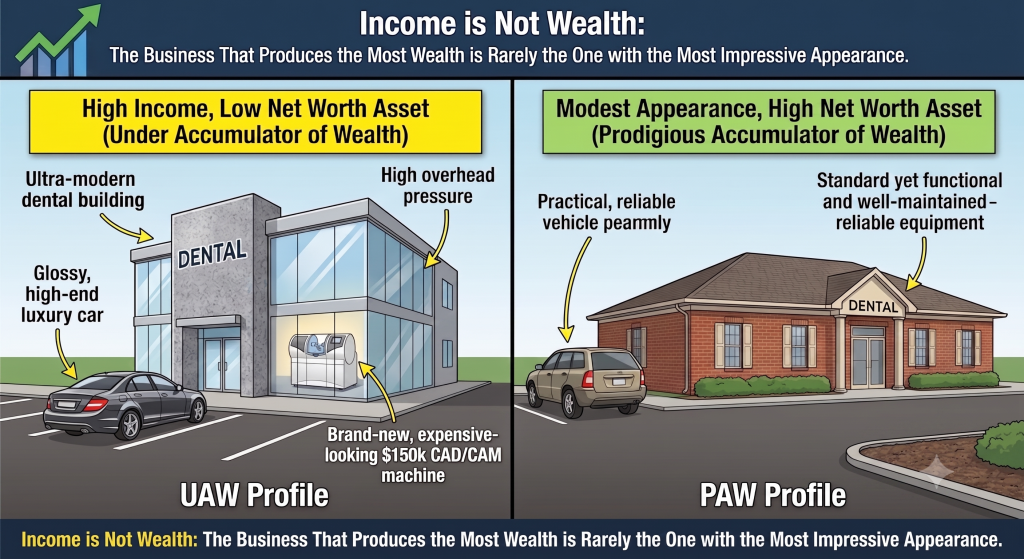
The book divides subjects into two types. PAWs (Prodigious Accumulators of Wealth) had net worth far exceeding what their income and age would predict. UAWs (Under Accumulators of Wealth) had net worth well below that predicted level, despite often earning substantial incomes. The key differentiator was not how much people earned. It was how they deployed what they earned.
Stanley and Danko’s research found that the typical PAW was a business owner who lived in a modest home, drove a practical vehicle, spent less than they made in every income bracket, and measured success by net worth rather than by appearances. They did not upgrade their lifestyle every time their income rose. They reinvested. They accumulated. And over time, they built fortunes that were invisible to the world because they were held in assets, not consumed in lifestyle.
The UAW, by contrast, often earned more than the PAW. They simply spent proportionally more as well. Bigger house. Newer car. Children’s private school. Club memberships. The income was there. The wealth was not.
The dentist on the yacht has more in common with the PAW than most of his colleagues, who spend $400,000 renovating their office.
Why “If You Build It, They Will Come” Is the Wrong Strategy
One of the most expensive beliefs a new or growth-stage dentist can hold is that patients choose a dental practice based on its equipment and aesthetics.
New dental graduates face enormous pressure to differentiate, to modernize, to invest in the latest technology as a signal of clinical quality. This pressure comes from equipment vendors, from continuing education programs built around new procedures, and from colleagues who have convinced themselves that their CEREC machine pays for itself.
The ADA’s Health Policy Institute data on dentist income trends shows that average general dentist net income in 2024 was approximately $208,000, a figure that has declined in inflation-adjusted terms despite rising gross revenues, in large part because overhead has consistently outpaced collections growth. Expensive equipment sits at the center of that overhead pressure. The CEREC machine, the cone beam CT scanner, and the digital pan unit: each one adds to the fixed cost base while delivering uncertain revenue returns.
The dentist in the brick building has no CEREC machine. He has patients. Thousands of them. Loyal ones who have been coming for years, who bring their children, who refer their neighbors, who stay because of the relationship, not because of the technology.
Stanley and Danko’s core insight applies directly: the business that produces the most wealth is rarely the one with the most impressive appearance. It is the one with the strongest fundamentals. In dentistry, the strongest fundamental is patient volume driven by genuine trust.
What Actually Builds a High-Value Dental Practice
The dentists who build genuinely valuable practices, the ones that sell for strong multiples with strong patient retention and minimal transition attrition, share consistent characteristics that have nothing to do with their equipment lists.
They have deep patient relationships built over years. Their hygienists have been there for a decade or more. Their front desk coordinator knows every patient by name. Their recall rates are high because patients actually want to come back, not because they’re receiving automated reminder texts.
Private Practice Research’s 2026 dental practice valuation framework identifies goodwill, which encompasses patient loyalty, staff continuity, and community trust, as the largest component of practice value, averaging approximately 75% to 80% of most dental practice purchase prices. Equipment, by contrast, is typically appraised at fair market value, which for most dental equipment means a fraction of its purchase price after depreciation.
A practice with $400,000 in updated equipment and 1,100 active patients is worth substantially less than a practice in a 20-year-old buildout with 2,800 loyal, active patients who return every six months because they trust their dentist. The brick building wins every time.
The Relationship Dividend: Why Patient-Centered Practices Outperform Technology-Centered Ones
The business case for relationship-centered dentistry is not just qualitative. It shows up in the financial metrics that determine practice value.
Patient retention rate is one of the most direct drivers of practice value because it determines recurring revenue. A practice with a 92% recall acceptance rate and 2,800 active patients generates more predictable, reliable cash flow than a technology-forward practice with 1,100 patients and a 70% recall rate, regardless of what the equipment appraisal looks like.
Per Private Practice Research’s analysis of patient retention in dental transitions, practices with deep staff and dentist-patient relationships experience post-sale patient attrition of 6% to 8% in well-managed transitions, while practices where goodwill is thin experience 18% to 22% attrition in the same period. The difference in retained patient value between those two scenarios often exceeds $200,000 in practice value.
A buyer purchasing a practice with deep patient relationships is buying something that will still be producing in year three and year five of their ownership. A buyer purchasing a technology-forward practice with thin patient loyalty is taking on significant post-acquisition risk.
The relationship dividend compounds across the life of the practice and is fully captured at the moment of sale.
Why High Income Is Not the Same as Wealth
This is where the Millionaire Next Door principle becomes most relevant to dentists specifically.
Dentistry produces high income. The ADA Health Policy Institute’s 2024 income data places average general dentist net income at approximately $208,000 annually, with specialists earning considerably more. That is top-5% income by most household measures.
But income and wealth are not the same thing. Dentist Advisors’ 2025 Annual Financial Benchmark Results documents a persistent reality: many dentists arrive at their intended retirement date with net worth concentrated almost entirely in practice equity, with limited liquid retirement savings outside that single illiquid asset. The practice was supposed to be the windfall. The practice was also the only plan.
Medical Economics reporting on physician and dentist retirement preparedness found that 40% of physicians are behind on retirement savings, despite earning top-percentile incomes. The primary drivers are the late income start from extended training, compounded by lifestyle inflation once high-income years begin. Dentists face the same pattern.
The dentist who nets $600,000 per year for 20 years and spends $590,000 per year is not wealthy. They have a high income and a lifestyle that requires it to be maintained. The dentist who nets $600,000 per year for 20 years and saves $150,000 of it consistently is building something durable.
How Dental Practice Owners Become PAWs Instead of UAWs
The path from income to wealth is not complicated. It is just uncommon.
The PAW dentist, in the Millionaire Next Door model, does several things that most high-income dentists don’t.
They maximize tax-advantaged retirement accounts every year from the first year of practice ownership. Davies Wealth Management’s 2026 guide on retirement planning for physicians and dentists identifies the combination of a defined benefit (cash balance) plan with a 401(k) as the most powerful wealth-building tool available to dental practice owners, with combined annual contributions that can exceed $300,000 per year for older owners, all tax-deductible. A dentist who maximizes these vehicles for 20 years arrives at retirement with a foundation that does not depend on the practice sale.
They start saving early. OJM Group’s compound interest analysis for physicians shows that early, consistent saving dramatically outperforms late, larger saving: a dollar invested at 35 compounds to roughly three times the value at 65 compared to a dollar invested at 50 at standard return assumptions. The dentist who defers serious saving until their 50s is making a permanent mathematical choice with permanent consequences.
They set the savings rate before setting the spending rate. NBER research on automatic savings enrollment confirms that pre-committing to savings through automatic contributions dramatically improves long-term accumulation by removing the decision from daily willpower and making it structural. The dentist who automatically diverts retirement account contributions before lifestyle spending is preallocated will accumulate at a different rate than one who saves whatever is left over at the end of the year.
They measure success by net worth, not gross income or equipment inventory. The dentist on the yacht has a 55-foot yacht because he accumulated wealth, not because he has status. That distinction is the difference between the PAW and the UAW.
What the Practice Sale Looks Like When You’ve Built It Right
The dentist in the brick building, when he eventually transitions, will have two significant advantages over colleagues who spent 20 years investing in equipment and lifestyle.
First, his practice will be worth more. Large, loyal patient bases, long-tenured staff, and documented cash flow that doesn’t depend on the owner’s clinical volume create the exact conditions that institutional and private buyers pay premium prices for. Private Practice Research’s marketed process analysis documents that practices with strong fundamentals, sold through structured, multi-buyer competitive processes, consistently achieve approximately 50% higher transaction values than those sold through unsolicited single-buyer approaches.
Second, he will not need to sell. When a dentist has built retirement savings independent of the practice over 20 or 25 years, they enter the transition conversation from a position of genuine financial security. They can wait for the right buyer. They can take the 6 to 12 months required for a structured, premium sale process. They can decline the first offer if it doesn’t reflect the value they’ve built. They have options.
The dentist who has not built wealth outside the practice is in a fundamentally different position. They may need to sell quickly, accept the first reasonable offer, and close in whatever market exists. Their retirement depends on the check, and the check depends on conditions they cannot control.
The Millionaire Next Door dentist doesn’t need the practice to be perfect to retire well. They need the practice to be one component of a financial picture that was built with intention. The practice sale is the capstone. Not the plan.
FAQs
What does “The Millionaire Next Door” teach dentists about wealth building?
Stanley and Danko’s research found that most high-income professionals are UAWs (Under Accumulators of Wealth): they earn well but spend proportionally, leaving little accumulated wealth relative to their income. The PAWs (Prodigious Accumulators of Wealth) in the research lived below their means, invested consistently, measured success by net worth rather than income, and built wealth that was invisible because it was held in assets rather than consumed in lifestyle. The lesson for dentists: income is not wealth. Behavior determines which category you end up in.
Do patients choose a dental practice based on technology and aesthetics?
Research on patient satisfaction and loyalty consistently shows that the primary drivers of patient retention are trust in the dentist’s clinical decisions, continuity of care, and the dentist’s knowledge of the patient’s health history. These are relationship assets, not equipment assets. Private Practice Research’s patient retention research confirms that practices with deep patient relationships experience 6% to 8% post-sale attrition, while thin-goodwill practices experience 18% to 22%, a difference that directly affects what the practice is worth.
How much should a dentist save per year for retirement?
Davies Wealth Management’s 2026 retirement planning guide for physicians and dentists recommends a minimum savings rate of 15% to 20% of gross income, with the 35-to-45 age window representing the highest-leverage compounding period. OJM Group’s physician compound interest research shows that early, consistent contributions dramatically outperform late, larger contributions over a 30-year horizon.
What is the PAW and UAW formula from “The Millionaire Next Door”?
The expected net worth formula from The Millionaire Next Door is: age multiplied by annual pre-tax household income, divided by 10. A PAW has a net worth at least twice that figure. A UAW has a net worth of less than half. A 50-year-old dentist earning $250,000 per year has an expected net worth of $1,250,000 under this formula. Where they actually land depends almost entirely on the spending and saving decisions they have made across their career.
Does a large patient base produce better practice sale outcomes?
Yes, significantly. Patient volume is one of the primary valuation drivers in dental practice transactions because it determines recurring revenue, supports hygiene production, and creates the competitive bidding that produces premium transaction values. Private Practice Research’s 2026 valuation framework confirms that goodwill, driven primarily by patient loyalty and volume, accounts for approximately 75% to 80% of most dental practice purchase prices. A practice with 2,800 loyal patients in an unassuming building will sell for more than a technology-forward practice with 1,100 thin-relationship patients.
How can a dentist build retirement security independent of the practice sale?
Maximize tax-advantaged retirement vehicles from the first year of practice ownership. Dentist Advisors’ 2025 benchmark data shows that dentists with the strongest wealth accumulation relative to income are the ones who save and invest consistently and actively track their financial progress. The combination of a 401(k) and defined benefit (cash balance) plan, consistently funded over 20 years, builds a retirement foundation that makes the practice sale an accelerant rather than the entire plan.
Conclusion
The dentist with the fly fishing photographs and the 55-foot yacht did not build his wealth by impressing patients with his waiting room. He built it by showing up four days a week for years, caring genuinely for the people who trusted him with their health, and spending less than he earned on everything else.
That is The Millionaire Next Door. Not a flashy appearance. Not the newest equipment. Not a practice designed to impress colleagues. A relationship-centered business that generates reliable cash flow, accumulates loyal patients, and compounds wealth over time for someone who understood from the beginning that income and wealth are not the same thing.
The dentist who wants to be this person 20 years from now needs to make two decisions today: build the practice on relationships, not renovations. And save more than feels comfortable in the years when income finally gives you the choice.
Find a dental practice decorated with wallpaper and pictures of a guy holding up a 12-inch salmon. There is a millionaire behind that door.