
It is the question every dental practice owner eventually asks, often more urgently than they expected, when the moment finally arrives.
What is my practice worth?
The answer is never a single number pulled from a formula. It is the product of multiple valuation methodologies, applied to the specific financial and operational characteristics of a specific practice, in a specific market, at a specific point in the economic cycle. And understanding how those methodologies work, what they measure, why they diverge, and which one applies to your situation, is the difference between entering a transition conversation armed with knowledge and entering it hoping the number on the report is one you can live with.
This article walks through every major approach used to value a dental practice in 2025, explains what each one captures and what it misses, and helps you understand why the valuation you receive from an experienced dental-specific advisor may look different from what you calculated on the back of an envelope.
Why Dental Practice Valuation Is Different from Other Business Valuations
Valuing a dental practice is not the same as valuing a retail store, a manufacturing company, or a professional services firm. The differences are specific and consequential.
First, the primary asset is intangible. Per Marcum LLP’s dental goodwill valuation research, goodwill in general dentistry averages approximately 52% of annual gross revenue and typically comprises 75% to 80% of total practice purchase price. The equipment, technology, and leasehold improvements are real and appraised separately, but they are not what determines the practice’s primary value. The patient relationships, community reputation, and staff continuity are.
Second, dental practices have a limited, specifically qualified buyer pool. The buyer must hold an active dental license, have the clinical capability to sustain or grow the practice’s production, and qualify for financing at a scale that matches the practice’s asking price.
Third, the income the practice generates must be separated from the income the selling dentist earns as a clinician. An owner-dentist who produces $400,000 per year in clinical work is running a business that employs them. The practice’s value as an investment must be calculated by replacing that clinical production with a market-rate associate compensation estimate, and what remains is the business’s true profit.
The ADA’s guidance on dental practice valuation identifies this clinical and business income separation as one of the most important and frequently mishandled elements of practice valuation. Sellers who conflate the two arrive at inflated value estimates. Buyers who fail to separate them overpay for what is essentially the seller’s personal production.
The Collections-Based Method
The most commonly cited dental practice valuation methodology uses annual gross collections as the baseline and applies a percentage range to arrive at an estimated value.
The standard range, per Private Practice Research’s 2026 dental practice valuation framework, is 65% to 85% of annual gross collections for private-party sales. This means a practice collecting $1,000,000 per year would typically be valued between $650,000 and $850,000 under this method.
The range is not arbitrary. It reflects:
- 65%: Lower-quality practices with high overhead, declining patient base, heavy owner dependence, or unfavorable market position
- 75%: Mid-range practices with healthy fundamentals, stable staff, reasonable overhead, and growing or stable collections
- 85% or above: High-quality practices with strong patient volume, low overhead, associate-driven production, and competitive buyer interest
The collections-based method is useful as a quick reference and market sanity check. Its limitation is that it ignores profitability. Two practices that both collect $1,000,000 per year can have radically different net incomes if one has 55% overhead and the other has 72% overhead. The collections-based method treats them as potentially equivalent. The more sophisticated valuation methods below correct for this.
Seller’s Discretionary Earnings (SDE)
When an individual dentist is buying a practice from another individual dentist, the transaction is almost always evaluated on Seller’s Discretionary Earnings, not on gross collections.
SDE represents the total economic benefit available to a single working owner from the business. It is calculated as:
SDE = Net Income + Owner’s Salary/Draws + Personal Add-Backs + Non-Recurring Expenses
The add-backs are the critical element. Most dental practice owners run legitimate personal expenses through the practice: vehicle leases, above-market compensation, spouse payroll, retirement contributions, continuing education travel, and personal health insurance. These expenses reduce the practice’s reported net income but are not costs a new owner would necessarily carry. When they are added back to net income, the result is SDE, the true economic output of the practice available to any owner.
Per Private Practice Research’s 2026 framework, SDE-based multiples for private buyer dental practice acquisitions typically run 1.75x to 2.25x. A practice with a verified SDE of $400,000 would therefore be valued at approximately $700,000 to $900,000 under this method.
The SDE method’s advantage is that it captures profitability. It corrects for overhead differences that the collections-based method ignores. Its limitation is that it is sensitive to add-back accuracy. Regal Capital’s quality of earnings guidance notes that add-backs can inflate stated SDE by 15% to 50% if not independently verified, which is why serious buyers commission a quality of earnings analysis before finalizing an offer.
EBITDA Multiples
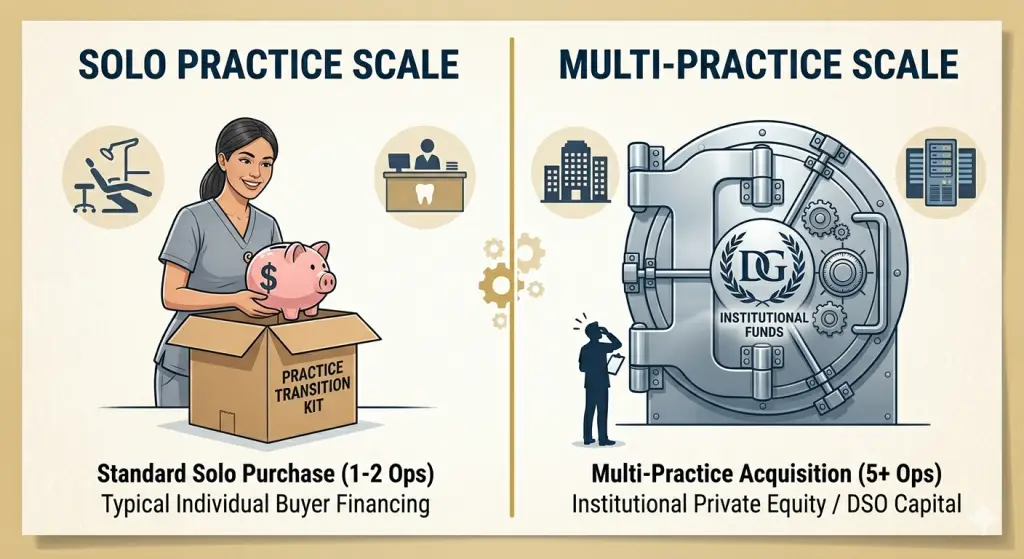
When a Dental Support Organization, a private equity-backed platform, or another institutional buyer evaluates a dental practice or dental group, they use a different valuation framework: EBITDA multiples.
EBITDA (Earnings Before Interest, Taxes, Depreciation, and Amortization) is a profitability metric that institutional buyers use across industries to evaluate investment returns. It differs from SDE in one critical way: EBITDA does not add back the owner’s compensation as if they were a sole working owner. Instead, it uses a market-rate associate pay estimate to replace the owner’s clinical production. This normalizes the earnings for an entity that will not have the selling dentist working as its primary producer.
Private Practice Research’s 2026 valuation framework documents the following EBITDA multiple ranges:
- Solo GP practices (private buyer eligible): approximately 4x to 6x EBITDA
- Platform-fit practices (DSO institutional buyers): approximately 6x to 9x EBITDA
- Platform-level and strategic acquisitions: 10x to 12x or above
The DSO premium exists because institutional buyers value dental platforms for their scalability and infrastructure, not just their current earnings. This is why a dental practice with $1,200,000 in annual collections and $480,000 in EBITDA might sell for $850,000 to $960,000 to a private buyer or for $2,400,000 to $3,360,000 to a well-positioned DSO. The same practice, in the same market, on the same day, with a dramatically different value depending on who is buying.
This disparity is not a negotiating illusion. It reflects genuinely different investment theses, capital structures, and return expectations between private buyers and institutional ones.
The Active Patient Method
The active patient count method is one of the oldest approaches in dental practice valuation, and one of the most intuitive for sellers who think about their practice in terms of the patients they serve.
Per Baker Tilly’s dental practice valuation guide, the goodwill value of a dental patient base is commonly estimated at $200 to $300 per active patient, where “active” is defined as a patient seen within the last 18 to 24 months. On this basis:
- 1,000 active patients = $200,000 to $300,000 in patient-based goodwill
- 2,000 active patients = $400,000 to $600,000 in patient-based goodwill
- 3,000 active patients = $600,000 to $900,000 in patient-based goodwill
This method is particularly useful as a cross-check against the collections-based method. A practice collecting $1,000,000 per year with only 800 active patients is producing approximately $1,250 per active patient per year, an exceptionally high number suggesting strong case acceptance or premium restorative mix, but also significant revenue concentration. A practice with 3,000 active patients generating $750,000 in annual collections is producing only $250 per patient per year, well below the benchmark, but signaling tremendous growth runway for a buyer who can optimize case acceptance and add service lines.
The Asset-Based Method
The asset-based valuation method assigns value to a practice based on its tangible assets: equipment at fair market value, leasehold improvements, computer systems, inventory, and supplies.
This method establishes a floor, the minimum a practice should be worth, even if it has no patients and no goodwill. In practice, asset-based valuations for dental practices rarely influence the final purchase price, because the goodwill and patient base value almost always exceed the tangible assets by a significant margin.
Dental Economics’ transitions guidance on evaluating dental equipment before a practice purchase notes that dental equipment is typically appraised at fair market value rather than replacement cost or book value, meaning older equipment that is fully depreciated on the seller’s books may still carry meaningful value as functional, maintained clinical tools.
Where the asset-based method matters most is in the purchase price allocation that follows closing. Buyers typically prefer to allocate more of the purchase price to equipment and leasehold improvements (which can be depreciated quickly) and less to goodwill (which is amortized over 15 years under IRS rules). Sellers typically prefer the opposite, because goodwill gains are taxed at capital gains rates. Understanding this tension is part of deal structuring, and it is separate from the valuation discussion.
The Five Variables That Move Every Valuation
Regardless of which methodology is applied, five specific variables consistently move dental practice valuations above or below the midpoint of any given range.
1. Overhead as a percentage of collections. The lower the overhead, the higher the profitability per dollar of collections, and the higher the valuation multiple. The Dental Accounting Organization’s 2026 U.S. Dental Practice Benchmarks identifies total overhead of 55% to 65% of collections as the healthy target range, with overhead above 70% typically triggering a buyer discount. A practice at 58% overhead and a practice at 72% overhead can have the same collections and dramatically different practice values.
2. Active patient count and trend. Volume matters, but trend matters more. A practice with 2,000 active patients whose count has grown from 1,600 over three years is worth more than a practice with 2,000 active patients whose count has declined from 2,400 over the same period. The trend tells the buyer where the practice is going. The count tells them where it is.
3. Owner dependence. Private Practice Research’s owner-dependence discount analysis documents that practices where the owner generates more than 90% of production sell for 10% to 20% lower on a price-multiple basis than practices with established associate production. When the full buyer-pool effect is considered, the effective discount widens to 25% to 40%. Practices that have diversified their production beyond the owner’s command a meaningful premium.
4. Payer mix. A practice with 60% fee-for-service collections produces more revenue per procedure than an equivalent practice with 80% PPO plan participation. Fee-for-service practices command higher valuation multiples because the revenue is less subject to insurer discount pressure. Every practice should understand its payer mix and what it implies for valuation.
5. Market conditions and buyer competition. The same practice listed in a favorable acquisition market with multiple qualified buyers will achieve a higher price than the identical practice listed in a contracting market with a thin buyer pool. Private Practice Research’s marketed process analysis confirms that practices sold through structured, competitive, multi-buyer processes achieve approximately 50% higher transaction values than those sold through unsolicited single-buyer approaches. The market is not a passive background condition. It is an active variable in what a practice is worth.
Why Two Identical Practices Can Have Different Values
Two dental practices can have identical annual collections, identical overhead percentages, identical active patient counts, and identical staff rosters and sell for materially different prices.
Practice A is listed through an experienced dental transition advisor who has relationships with three credible, qualified buyers in the market. The buyer pool is competitive. Two buyers submit offers within 10% of each other. The seller, without urgency, negotiates from strength. The practice sells for 82% of annual collections.
Practice B has the same fundamentals, but the owner listed it on a dental practice marketplace website after receiving an unsolicited offer from a single buyer. The single buyer, knowing there is no competition, offers 63% of annual collections. The seller, under some personal time pressure, accepts.
Both practices were worth the same in an objective financial sense. One sold for 30% more than the other. The difference was not the practice. It was the process.
This is the most important valuation insight that most sellers miss: the methodologies determine a range. The process determines where, within that range, or above it, you actually land.
Getting a Professional Dental Practice Valuation
A professional dental practice valuation is an independent, documented analysis of the practice’s financial and operational characteristics, conducted by a credentialed advisor with dental-specific experience, producing a defensible value range supported by methodology and market data.
The American Dental Association’s guidance on starting with an accurate valuation recommends commissioning a valuation from a specialist before entering any sale process, because a practice that is mispriced at listing either too high or too low pays a high cost. Too high: the practice sits on the market, accumulates stigma, and ultimately sells for less than a correctly priced listing would have achieved. Too low: the seller leaves money behind that a properly conducted marketing process would have captured.
A comprehensive dental practice valuation should include:
- Three to five years of production and collection data, reviewed against ADA and industry benchmarks
- A formal SDE calculation with every add-back documented and defensible
- A collections-based midpoint and range
- A patient-based assessment including active count, demographics, new patient trend, and recall rate
- A market context summary, including competitive density, DSO activity, and comparable transactions in the area
- A final value range across methodologies, with a recommended approach for the specific practice and anticipated buyer profile
The BizBuySell dental practice valuation benchmark data provides useful market context for what practices of comparable size and specialty have actually sold for, as a cross-check on methodology-derived valuations. In 2025, median sale prices for dental practices have risen alongside improving earnings multiples, with practices generating revenue above $800,000 commanding earnings multiples of approximately 3.4x or higher.
Whether the practice is actively for sale or not, an accurate valuation is important for retirement planning, partner buy-in discussions, estate planning, or simply as a measure of the practice wealth you have built. A good valuation promotes an understanding of how value is created and maintained, helps position the practice for an eventual transition, and encourages the owning dentist to examine and maintain strong net cash flow.
FAQs
What is the most common way to value a dental practice?
The collections-based method is the most widely used starting point, typically expressing value as 65% to 85% of annual gross collections. Per u003ca href=u0022https://privatepracticeresearch.org/reports/how-dental-practices-are-valued-2026u0022u003ePrivate Practice Research’s 2026 valuation frameworku003c/au003e, more sophisticated buyers also apply SDE multiples of 1.75x to 2.25x for private transactions, or EBITDA multiples of 4x to 12x or more for institutional buyers. All three methods should be run for any serious valuation, because they reveal different dimensions of the practice’s value.
What is goodwill, and how much of a dental practice’s value is it?
Goodwill represents the intangible value of a dental practice beyond its physical assets: patient loyalty, community reputation, staff continuity, and the trust the selling dentist has earned over their career. u003ca href=u0022https://marcum01.wpenginepowered.com/insights/dental-practice-goodwill-how-to-identify-measure-and-value-itu0022u003eMarcum LLP’s researchu003c/au003e documents that goodwill averages approximately 52% of annual gross revenue in general dentistry and typically represents 75% to 80% of the total practice purchase price.
How do active patients affect dental practice value?
Active patients (those seen within the last 18 to 24 months) carry a goodwill value of approximately $200 to $300 per patient, per u003ca href=u0022https://www.bakertilly.com/insights/a-dentists-guide-to-dental-practice-valuation-methodsu0022u003eBaker Tilly’s dental practice valuation guideu003c/au003e. Beyond the per-patient value, the total active patient count and its trend direction both influence how buyers and lenders assess the practice’s revenue stability and growth potential.
Does overhead affect dental practice value?
Significantly. Overhead as a percentage of collections directly affects the practice’s profitability per dollar of revenue, which determines the SDE and EBITDA figures on which most valuations are built. u003ca href=u0022https://www.dentalaccounting.org/blog/2026/05/20/2026-u-s-dental-practice-benchmarks/u0022u003eThe Dental Accounting Organization’s 2026 benchmarksu003c/au003e identify 55% to 65% as the healthy overhead range. Every percentage point above the benchmark reduces the income available to service acquisition debt and pay the new owner, which compresses the price a buyer can support.
Will a DSO offer me more than a private buyer?
Often yes, because DSOs apply EBITDA multiples (typically 5x to 9x for platform-fit acquisitions) that are significantly higher than the 1.75x to 2.25x SDE multiples used in private transactions. However, the DSO’s headline offer frequently includes earnout components with realization risk, post-close employment obligations, and rollover equity with limited liquidity. u003ca href=u0022https://privatepracticeresearch.org/reports/is-your-dso-offer-fairu0022u003ePrivate Practice Research’s DSO offer evaluation frameworku003c/au003e documents earnout realization rates ranging from 40% to 100% of face value, meaning the headline price may overstate actual realized proceeds. Always have the total DSO offer modeled by a dental-specific CPA before comparing it to a private-party offer.
How often should I get my dental practice valued?
The ADA recommends obtaining a professional valuation at every major planning milestone: before a sale process, during partnership formation or buy-in discussions, for estate planning purposes, and whenever significant operational changes affect the practice’s financial profile. A practice that was valued three years ago at $800,000 may be worth $1,100,000 today in a stronger market, or $650,000 if overhead has increased and patient count has declined. Valuations are snapshots, not permanent answers. At TransitionOne, we provide a complimentary practice valuation for both buyers and sellers, because every transition deserves to start from an accurate, current picture of value.
Conclusion
A dental practice valuation is not a number. It is a range, defined by multiple methodologies, shaped by the practice’s specific financial and operational characteristics, and ultimately determined by who is buying and how the sale process is conducted.
Understanding that range, how it is calculated, what moves it up or down, and what the difference between a private buyer’s offer and an institutional buyer’s offer actually means in after-tax, realized dollars, is the foundation of every successful dental practice transition.
Every practice is unique. Using one outdated formula or rule to determine practice value can set you up for a costly mistake. The dentist who knows what their practice is worth, and why, enters the transition conversation with genuine leverage. The dentist who doesn’t is negotiating in the dark.
Regardless of whether your practice is for sale today, an accurate valuation is one of the most valuable investments a practice owner can make in their own financial future.