
At some point in nearly every dentist’s career, the question of ownership arises. The associate position that was supposed to be temporary has stretched into a second or third year. The desire to build something, to have a patient base that is genuinely yours, to operate without someone else’s protocols and priorities governing every clinical decision, that desire becomes impossible to ignore.
And then the decision: purchase an existing practice, or build one from the ground up?
Most dentists who have been through both sides of this comparison eventually arrive at the same conclusion. The math for purchasing an established dental practice is more favorable than most new ownership candidates realize, and the math for starting from scratch is more punishing than almost anyone anticipates before they sign the lease.
This article walks through the complete financial and strategic comparison so that the decision can be made with accurate inputs rather than assumptions.
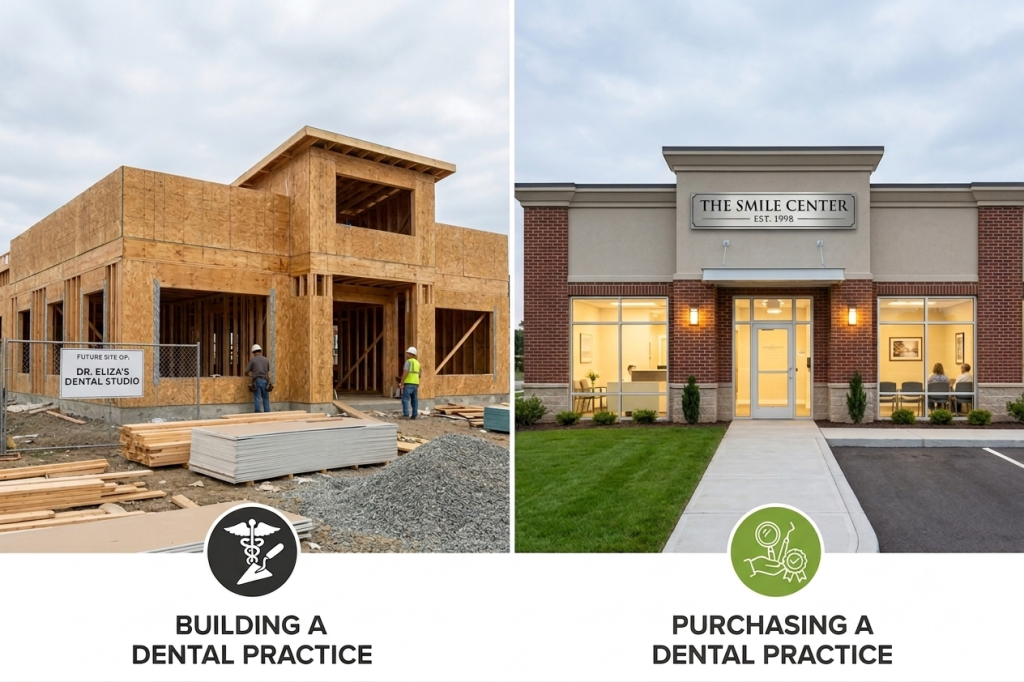
The True Cost of Starting a Dental Practice from Scratch
The budget figure most dentists bring to their first de novo conversation is based on an estimate, one often informed by equipment vendor presentations, contractor conversations, or rough comparisons to what colleagues have spent. That budget is almost always lower than the actual all-in cost, and the gap between the estimate and the reality is where many new practice owners run into serious financial trouble.
Scott Leune’s comprehensive 2025 dental practice startup cost breakdown, drawing on ADA Health Policy Institute data from 847 new practices, documents the following average cost structure for a de novo dental practice start:
- Equipment and technology: $325,000 (43% of total)
- Buildout and construction: $185,000 (24%)
- Working capital for the first six months: $145,000 (19%)
- Professional fees (legal, accounting, consulting): $65,000 (9%)
- Marketing and pre-launch: $35,000 (5%)
- Total average startup capital: $750,000 to $1,200,000
And that figure does not include the hidden costs that typically follow: technology integration at 35% above the equipment price, OSHA and regulatory compliance upgrades averaging $45,000 (up 67% since 2019), insurance costs running approximately $2,800 per month versus the $1,200 that most startup budgets project, and ongoing patient acquisition costs averaging $289 per new patient in 2024, up from $85 in 2015.
The American Dental Association’s guidance on financial paths to practice ownership places the all-in startup cost range at construction costs of $250,000 to $500,000, equipment of $100,000 to $200,000, and additional working capital, with the total well above what most candidates initially budget. By contrast, the purchase price of an established dental practice with $1,000,000 to $1,200,000 in annual collections typically falls in the range of $700,000 to $1,000,000, per Private Practice Research’s 2026 dental practice valuation framework. That price includes the physical assets, the patient base, the trained staff, the operational history, and the goodwill that took the previous owner decades to build.
On a raw cost basis, the two paths often require similar initial capital. The critical difference is what that capital buys.
The Time Cost
The de novo practice starts with zero patients and zero revenue. Every patient must be acquired through marketing, referrals, or community visibility. Every staff relationship must be built from scratch. Every operational system must be tested and refined. The practice must find its footing before it can find its ceiling.
Rework’s 2025 dental practice growth stage analysis documents the startup trajectory in specific terms:
- Only 27% of new dental practices break even within 18 months
- The average break-even point is 24 to 30 months
- Monthly production targets of $45,000 to $75,000 by month 12 are typical benchmarks for a well-performing startup
- By year three, a maturing practice may reach $600,000 to $1,200,000 in annual production
Compare that to the acquired practice. From the first day of ownership, the buyer inherits a scheduled appointment book, a trained staff, a known patient base, and insurance credentialing that resumes normal reimbursement flow once transferred. Production does not start at zero. It starts near where the seller left it.
The ADA’s financial paths to practice ownership analysis estimates the cash flow advantage of acquisition over a de novo start at $400,000 to $600,000 over the first three years of ownership. This figure represents the cumulative difference between generating near-full production from day one and building from zero over 24 to 36 months.
What an Existing Dental Practice Delivers on Day One
The list of what a buyer receives upon completing a dental practice acquisition is specific, documented, and immediately productive:
An active patient base. Per Baker Tilly’s dental practice valuation guide, a verified active patient base represents $200 to $300 in goodwill value per active patient. A practice with 2,000 active patients carries $400,000 to $600,000 in patient-based goodwill value. Those patients have scheduled appointments. They trust the practice. Many have been coming for years. They do not need to be acquired. They need to be retained.
A trained, experienced staff. The hygienist who has been scheduling the same patients for a decade, the front desk coordinator who knows every insurance quirk and every patient preference, the dental assistant who anticipates the owner’s next move in the chair, these are not just employees. They are the operational infrastructure of the practice. Replacing them costs time, money, and patient loyalty.
A verified revenue history. The acquired practice has three years of financial records documenting what it collected, what it cost to operate, and what the owner took home. This history enables accurate financial projections, informs the buyer’s practice management decisions, and satisfies the lender’s underwriting requirements. The de novo practice has none of this.
A community presence and reputation. The acquired practice is known in its community. Word-of-mouth referrals and the community relationships the seller built over decades of patient care do not disappear with the ownership change. They transfer with the practice if the transition is managed correctly.
The Five-Year Financial Comparison
The most direct way to understand the financial gap between purchasing and starting is to run the numbers side by side across a five-year horizon.
Consider two dentists, each investing approximately $500,000 to $750,000 in their path to ownership:
| Year | Purchased Practice (Collections) | De Novo Practice (Collections) |
| Year 1 | $700,000 (immediate from existing patients) | $300,000 (building from zero) |
| Year 2 | $900,000 | $450,000 |
| Year 3 | $1,000,000 | $600,000 |
| Year 4 | $1,100,000 | $750,000 |
| Year 5 | $1,200,000+ | $900,000 |
| 5-Year Total | $5,000,000+ | $3,000,000 |
| Est. Net Income (40% / 35%) | $2,000,000 | $1,050,000 |
The difference in five-year net income between those two paths exceeds $1,000,000, and that figure does not account for the below-market salary the de novo dentist draws during year one while the practice is not yet generating enough revenue to pay a full owner salary. Nor does it account for the compounding effect of delayed retirement savings or the additional equity the acquisition dentist builds in an appreciating asset from year one.
This is not a 1-year or a 5-year income decision. It is a 25- to 35-year income decision. And the path chosen in year one creates a trajectory that compounds in both directions for decades.
The Financing Comparison
Lenders make decisions based on demonstrated cash flow, not projected cash flow. An existing dental practice with three years of verified collections is a fundamentally different lending proposition than a de novo practice whose projections are entirely hypothetical.
The SBA’s 7(a) loan program is the dominant financing vehicle for dental practice acquisitions, providing up to $5 million in loan financing with favorable terms for acquisitions of established, cash-flowing businesses. Dental practices have historically been among the best-performing categories in SBA-backed commercial lending, with default rates consistently below 1.5% across the portfolio.
The de novo dental practice does not benefit from the same lender confidence. A startup practice has no revenue history to underwrite, no patient base generating predictable recurring income, and no comparable transaction to validate the projected economics.
Bank of America’s dental practice acquisition guidance confirms that established practices with documented cash flow are substantially easier to finance, with many lenders offering 100% financing for qualified buyers of established practices while requiring more equity for de novo starts. The debt service coverage ratio that lenders require, typically 1.20x to 1.25x, is straightforwardly achievable on an existing practice with verified net income. On a startup, it is a financial projection of a practice with no revenue history.
The Goodwill Equation
Goodwill is the largest asset in most dental practice transactions. According to Marcum LLP’s dental goodwill valuation research, goodwill in general dentistry averages approximately 52% of annual gross revenue and typically comprises 75% to 80% of the total practice purchase price. It represents patient loyalty, community trust, staff continuity, and the reputation the selling dentist has earned over an entire career.
The de novo practice has no goodwill at opening. None. Every patient must be acquired rather than retained. Every trust relationship must be earned rather than inherited. The practice’s name means nothing to the community on day one, because the community has never heard it.
Building that goodwill takes years. According to MDPI’s peer-reviewed research on factors influencing patient satisfaction and loyalty in dental practices, examining 1,121 patients and 77 dentists across 41 practices, the strongest predictors of patient loyalty are trust in the dentist’s clinical decisions, continuity of care, and the dentist’s knowledge of the patient’s medical history. These are relationship assets that accumulate through repeated interactions over time. They cannot be generated through marketing campaigns or grand opening events.
An acquired practice brings those trust relationships, those continuity assets, and that community reputation as part of the purchase. The buyer does not start at zero on the patient relationship dimension. They start where the seller left off, which in a well-run practice is a very strong position.
When De Novo Makes Strategic Sense
The financial argument for acquisition is compelling across most markets and most buyer profiles. But de novo is the right answer in specific circumstances that deserve explicit acknowledgment.
When no suitable practice is available for acquisition. In rural or underserved markets, there may simply be no established practice available for sale at any given time. A dentist committed to serving a specific community may have no acquisition path. De novo is not a choice in that circumstance it is the only option.
When institutional backing changes the economics. Dental support organizations frequently use de novo as a growth strategy, funded by institutional capital and supported by centralized marketing, staffing, and administrative infrastructure. Precedence Research’s U.S. DSO Market Analysis projects the sector growing from $155.65 billion in 2025 to $302.54 billion by 2035, with de novo expansion contributing significantly to that growth through institutional platforms with centralized resources that individual buyers cannot replicate.
When specialty credentials create referral-based patient flow. An oral surgeon, periodontist, or orthodontist opening in a market with documented unmet demand faces a different patient acquisition challenge than a general practitioner entering a competitive urban market. Specialist referrals from general dentists can generate an initial patient flow that de novo general practices cannot access.
For most individual general dentists, in most markets, acquisition produces superior financial outcomes. The circumstances above are genuine exceptions; they are not rationalizations for a decision that the financial analysis does not support.
The Hidden Advantage of Buying
There is a dimension of the acquisition versus de novo comparison that rarely appears in the standard financial analysis: the acquired practice pays for its own purchase.
A dental practice generating $1,200,000 in annual collections with $480,000 in normalized net income can service its acquisition debt while simultaneously providing the new owner with a market-rate salary. The practice produces enough income to cover the loan, pay the dentist, and still generate positive cash flow from year one.
The de novo practice does not have this property. In the first one to three years, the de novo practice does not generate enough revenue to cover its debt service, pay the owner a meaningful salary, and fund operating costs simultaneously. The owner typically draws a below-market salary during the build period, subsidizing the practice’s early growth from savings or other income sources.
Per Private Practice Research’s analysis of marketed dental practice sale processes, practices sold through structured, competitive, multi-buyer processes achieve approximately 50% higher transaction values than those sold through unsolicited single-buyer approaches. This means strong practices are actively available in the acquisition market, buyers who are prepared and pre-qualified can move quickly when the right opportunity appears, and the financial infrastructure around dental practice acquisitions is mature, well-developed, and designed to support successful outcomes.
The de novo practice does not have that infrastructure on its side. It has a contractor, an equipment salesperson, and a marketing plan that must produce the patient volume the financial model requires.
The highest default rate in dental practice financing is the startup practice. Ask any lender. Regardless of the entrepreneurial vision and passion you might have for dentistry, the startup gamble is just that, a gamble with your future that may cost hundreds of thousands of dollars in lost income over the first five years. The math with an established dental practice is simply better.
FAQs
How much does it cost to start a dental practice from scratch?
According to Scott Leune’s 2025 dental practice startup cost analysis, drawing on ADA data from 847 new practices, total startup capital averages $750,000 to $1,200,000, including equipment, buildout, working capital, professional fees, and pre-launch marketing. Hidden costs, including technology integration, regulatory compliance, and higher-than-projected insurance, typically add another $180,000 beyond initial estimates. High-cost urban markets regularly exceed these figures.
How long does it take a new dental practice to break even?
Research on dental practice growth stages shows that only 27% of new practices break even within 18 months, with the average break-even occurring at 24 to 30 months. The practice typically reaches $600,000 to $1,200,000 in annual production by year three to five, which is the level a comparable acquisition would have provided from the first month of ownership.
What does an established dental practice provide that a startup cannot?
An established dental practice provides immediate cash flow from an active patient base, a trained and experienced staff, three years of verified financial history, existing insurance participation, and the community goodwill that Marcum LLP’s research shows represents approximately 52% of annual gross revenue in general dentistry valuations. A de novo practice provides none of these on day one.
Why do lenders treat dental practice acquisitions differently from de novo starts?
Lenders underwrite dental practice loans based on demonstrated cash flow. An established practice has three years of verified collections, a known patient base, and comparable transactions to validate the purchase price. A de novo practice has financial projections but no revenue history. The SBA 7(a) loan program and specialty dental practice lenders routinely offer 100% financing for qualified buyers of established practices while requiring more equity and more conservative underwriting for de novo starts.
Is it possible to build a successful dental practice from scratch?
Yes, and many dentists do. De novo practice development is a viable path, particularly in underserved markets with limited acquisition options, for DSO-backed expansion with institutional resources, or for specialists entering markets with documented referral demand. For most individual general dentists in competitive markets, however, the ADA’s financial comparison of the two paths estimates a $400,000 to $600,000 cash flow disadvantage for the de novo path over the first three years of ownership compared to acquiring an established practice.
What is the best way to find an established dental practice to purchase?
The best dental practice acquisition opportunities rarely reach public listings. They move through advisor networks, dental-specific transition advisors with existing buyer and seller relationships, and the professional connections that active buyers develop over years in their target markets. Private Practice Research’s analysis of marketed dental practice processes confirms that practices sold through structured, multi-buyer processes achieve approximately 50% higher transaction values than unsolicited single-buyer transactions, demonstrating both the competitive buyer interest in established practices and the value of connecting with the right advisor network before a listing goes public.
Conclusion
The financial comparison between purchasing an established dental practice and starting one from scratch is not particularly close. The acquisition delivers immediate cash flow, a proven patient base, a trained team, verified financial history, and goodwill built over decades. The de novo start delivers control, optionality, and a blank slate, alongside two to three years of below-market compensation, $750,000 to $1,200,000 in upfront capital requirements, and a patient acquisition cost structure that did not exist the moment an existing patient base was available for purchase instead.
Both paths can work. Both have produced successful practices and successful dentist-owners. But the financial realities favor acquisition for most buyers in most markets, and understanding those realities before making the decision is what separates a choice from an assumption.
This is not a one-year decision. It is a 25- to 35-year income decision. Instead of gambling your future on a startup practice and taking years to become profitable, do the math with an established dental practice to maximize your chance of success.
The right practice is not the one you build first. It is the one you build best.