
The best bank for a dental practice loan is rarely the one with the lowest advertised rate. It is the lender whose full package (rate, amortization, interest-only period, working capital, fees, and the banking services that come with it) produces the lowest lifetime cost and the most flexibility as your practice grows.
Buying a practice is likely the largest financial commitment of your career, and the loan you sign will shape your cash flow for 10 to 15 years. This guide explains what separates specialized dental lenders from general commercial banks, profiles the lenders most active in dental acquisitions, and shows how to compare offers on total cost rather than headline rate.
Specialized healthcare lenders vs. general commercial banks
The core difference is how each lender values a dental practice. General commercial banks lean on tangible collateral, historical financial statements, and conventional lending ratios. Specialized dental lenders recognize that most of a practice’s value sits in intangible assets: goodwill, patient relationships, and established cash flow.
That understanding lets specialized lenders build financing around how dental acquisitions actually work, including:
- 100% financing of the purchase price, so buyers aren’t forced to drain savings for a down payment
- Additional working capital to cover payroll, supplies, and marketing while collections ramp up
- Flexible repayment terms, often with longer amortization periods
- Interest-only periods that ease cash flow during the ownership transition
Specialized lenders also understand the transition risks unique to dentistry: insurance credentialing delays, patient retention, clinical production, and the jump from associate to owner. Because they evaluate both the buyer’s clinical qualifications and the practice’s financial performance, underwriting is often faster and more predictable.
Experience shows up at closing, too. Dedicated dental lending teams know the acquisition process and coordinate with brokers, attorneys, and sellers to keep the deal on schedule. The result is more financing flexibility, a smoother closing, and a banking relationship built for a practice owner’s long-term needs.
Leading dental practice lenders to know
A handful of lenders with dedicated dental divisions handle a large share of U.S. practice acquisitions. Each has a distinct strength, so the right fit depends on your deal, your credit profile, and how you want to bank after closing.
| Lender | Structure | What stands out |
|---|---|---|
| Bank of America Practice Solutions | Dedicated division of a national bank | Endorsed by more state dental associations than any other lender; Preferred Rewards members can earn a 0.25%–0.35% rate discount on new Practice Solutions loans (details) |
| Provide (Fifth Third Bank) | Healthcare-focused lender, a division of Fifth Third | Up to 100% acquisition financing, working capital and six months of interest-only payments; full banking suite including merchant services and a practice credit card |
| U.S. Bank | National bank with dedicated healthcare practice financing | Offers financing for dental practice acquisitions, startups, expansions, equipment, and commercial real estate; combines practice lending with comprehensive business banking and treasury management services. |
| United Midwest Savings Bank | Regional bank with a nationwide SBA lending platform | Specializes in SBA-backed small-business financing, including practice acquisitions, startups, and commercial real estate; offers flexible financing structures for borrowers who may not qualify for conventional bank loans. |
Regional banks with healthcare teams, such as Huntington and TD Bank, are also active in many markets. Programs, discounts, and rates change often, so confirm current terms directly with each lender before you apply.
Building your shortlist: six criteria
Narrow the field to two to four lenders before you apply, judging each on these six criteria.
| Criterion | What to compare |
|---|---|
| Loan interest rate | Fixed vs. variable, and the overall cost of borrowing, including fees |
| Amortization period | 10 vs. 15 years, and the effect on your monthly payment |
| Interest-only period | Whether reduced payments are available during the first months of the transition |
| Working capital | How much extra financing is available to support operations after closing |
| Cost of the full banking suite | Merchant processing fees, business credit cards, checking accounts, and any other required services |
| Bank and relationship manager responsiveness | Communication, reliability, dental expertise and willingness to solve problems during the deal and after |
The last two are easy to overlook. Many lenders expect you to move your operating accounts and card processing to them, and those fees recur every month for the life of the practice. A responsive relationship manager who knows dentistry can be the difference between closing on schedule and losing a deal.
Non-rate terms that drive lifetime cost
Two loans with nearly identical rates can differ by hundreds of thousands of dollars over their life. Beyond the rate, evaluate:
- Amortization period. A longer term lowers the monthly payment but increases total interest if you carry the loan to maturity.
- Interest-only period. Reduced payments in the first months protect cash flow while you retain patients and get credentialed.
- Working capital. Enough cushion to cover payroll and supplies while collections ramp up, without reaching for expensive short-term credit.
- Prepayment penalties. These determine whether you can pay the loan down early or refinance without a large fee.
- Rate reduction and refinance options. Some lenders will lower your rate or restructure an existing loan without a full refinance, which matters if rates fall or your practice outgrows its original terms.
Example: same loan, two structures
Consider an $800,000 acquisition loan offered two ways. These figures are illustrative, not quotes.
| Offer A | Offer B | |
|---|---|---|
| Rate (fixed) | 8.50% | 8.75% |
| Amortization | 10 years | 15 years |
| Interest-only period | None | 6 months |
| Payment, first 6 months | $9,919 | $5,833 |
| Payment after that | $9,919 | $8,130 |
| Total interest if held to term | $390,000 | $650,000 |
Offer B carries the higher rate and far more total interest if held to maturity. Yet it frees roughly $4,000 a month during the transition and about $1,800 a month afterward, cash you can use to stabilize the practice. If Offer B has no prepayment penalty, you can make extra principal payments once the practice is steady and close much of the interest gap. The “best” offer depends on whether cash-flow cushion or lifetime cost matters more to you, and on the prepayment terms that let you have some of both.
Using multiple offers to negotiate
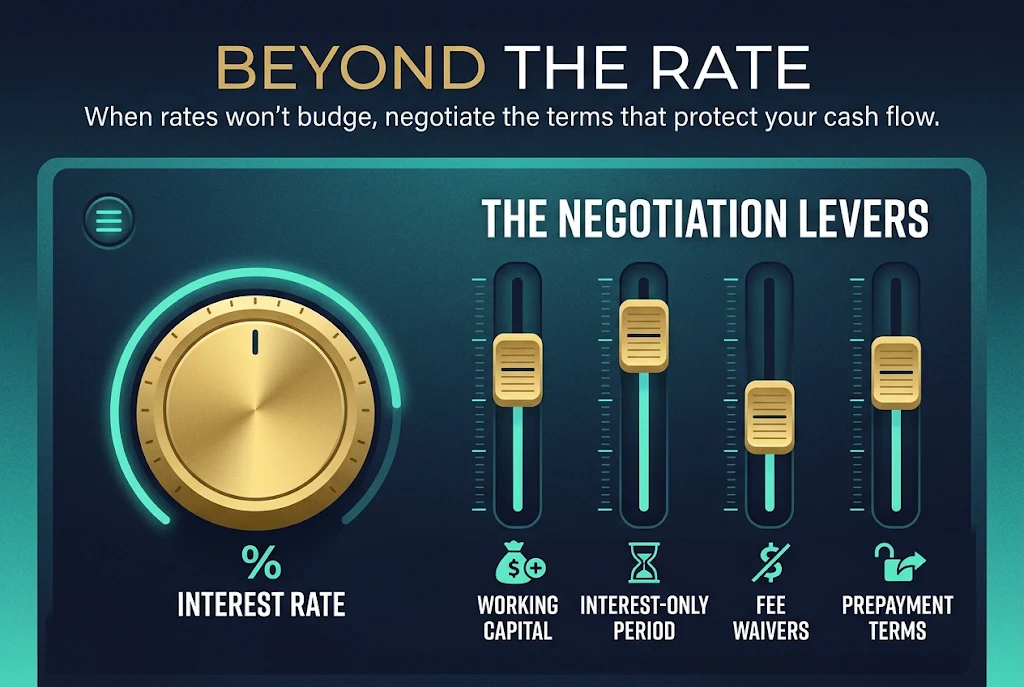
Competing term sheets are your strongest leverage, and the rate is only one lever. A lender that can’t move on rate may still:
- Increase working capital
- Extend the amortization period
- Add or lengthen an interest-only period
- Waive origination or other fees
- Improve prepayment or other loan terms
Banks want more than one loan from you. A practice owner is a long-term relationship that can include merchant services, business credit cards, deposits, and future financing for equipment, expansion, or real estate. Make it clear you’re comparing offers, share the specific terms you want matched, and ask each lender what it can do on the whole package.
Risks of a local bank without a dental division
Local community banks can offer competitive financing and strong personal relationships, but a lender without a dedicated dental or healthcare division brings real limitations.
Tighter terms at closing. General commercial lenders may be less familiar with dental valuations, goodwill-based lending, insurance credentialing, and practice cash flow. To offset that uncertainty, they may require larger down payments, additional collateral, or more restrictive loan terms.
Less flexibility later. Specialized dental lenders offer industry-specific products: acquisition loans with 100% financing, interest-only periods, equipment financing, expansion loans, and commercial real estate financing. Some also let you reduce your rate or restructure an existing loan without a full refinance. A local bank may have none of these programs, which can limit your options as the practice grows or market conditions change.
If you prefer a community bank, ask directly how many dental acquisitions it has financed, whether it will lend against goodwill, and what it offers for equipment, expansion, and real estate down the road.
The bottom line
The best bank for your dental practice loan is the one whose complete offer fits your transition and your long-term plans. Shortlist lenders with dedicated dental teams, compare every offer on lifetime cost and flexibility rather than rate alone, and use competing offers to improve the whole package. Then choose the relationship manager you trust to support you well after closing.
This article is for general information only and is not financial or legal advice. Lender programs and rates change frequently; confirm current terms with each lender and review offers with a dental CPA and attorney.