
Most dentists think about selling their practice in personal terms. They think about when they’ll be ready emotionally, when they’ll have saved enough, when their body signals it’s time to slow down. These are legitimate inputs. They are also entirely within the dentist’s control.
What is not within the dentist’s control is the economic cycle. And the economic cycle has more influence over the value a dental practice commands at closing than almost any other external factor.
The U.S. economy has experienced a recession or significant market contraction approximately every 7 to 10 years across modern economic history. Each contraction has produced measurable, documented reductions in dental practice transaction values, patient volume, consumer spending on elective dentistry, and lender appetite for practice acquisitions. Each one has trapped a meaningful number of dentists who were planning to sell but didn’t move early enough.
This article is not about pessimism or market timing. It is about integrating a variable that most dentists ignore entirely into the most important financial planning decision of their career.
The Historical Pattern of U.S. Recessions
The United States has experienced economic recessions with regularity throughout its modern history. Understanding the pattern is not about predicting the next crisis. It is about recognizing that economic contractions are a structural feature of market economies, not rare exceptions.
The National Bureau of Economic Research’s official business cycle data, which represents the authoritative record of U.S. economic expansions and contractions, documents every recession since the 1850s. The NBER defines a recession as a significant decline in economic activity that is widespread across the economy and lasts for more than a few months. Looking at the period from 1980 forward, the U.S. experienced significant contractions in 1980 to 1982, 1990 to 1991, 2001, 2007 to 2009, and 2020, a pattern representing roughly one recession every 7 to 10 years, though the spacing, severity, and duration vary considerably.
According to USAFacts’ historical recession analysis drawing on NBER data, the U.S. has experienced 34 recessions since 1855, with 13 occurring after World War II. Post-war recessions have averaged approximately 10 to 14 months in duration, with the Great Recession of 2007 to 2009 lasting 18 months and the COVID-19 contraction of 2020 lasting just two months.
The dentist who is 55 years old today and planning to sell in 10 years will likely be planning their exit across a window that includes at least one meaningful economic contraction. The dentist who acts in the next 12 to 24 months can capture the value that exists now without that uncertainty.
What Recessions Actually Do to Dental Practice Values
The financial impact of economic contractions on dental practice values is documented and measurable.
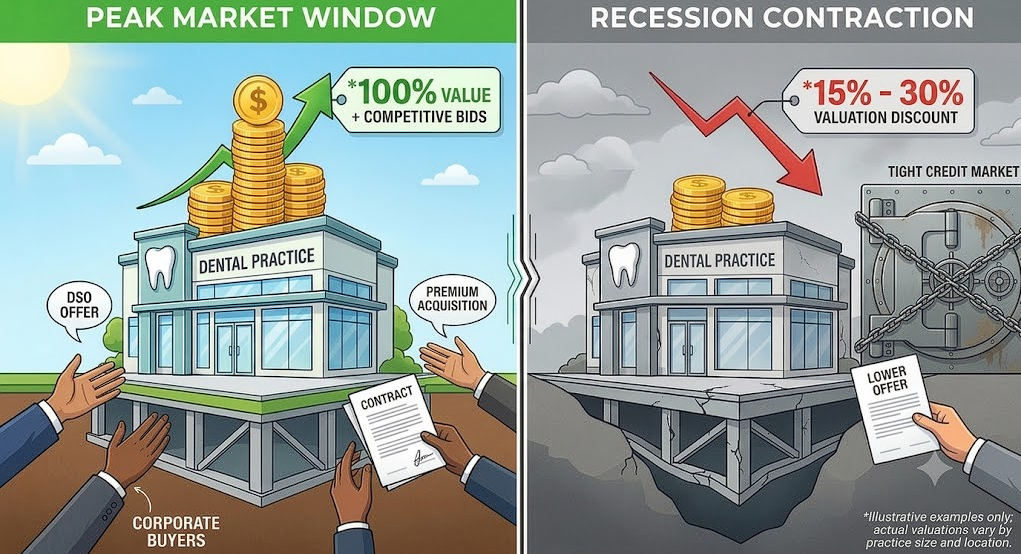
Exit Ready Advisors’ analysis of lower middle market business valuations during recessions found that well-prepared businesses typically experience valuation discounts of 15% to 30% during downturns, driven by tighter credit markets, lower buyer confidence, and compressed EBITDA multiples. For dental practices, this mechanism plays out through two channels simultaneously.
First, patient volume and production decline as consumers facing job loss, insurance disruption, and financial stress defer elective dental work. A practice generating $600,000 in net income under normal conditions may generate $480,000 to $510,000 during a meaningful contraction. Second, the acquisition market itself tightens: lenders reduce loan-to-value ratios, qualifying standards increase, and the pool of financially capable buyers shrinks. The compressed EBITDA, combined with fewer active buyers, eliminates the competitive bidding that drives premium valuations in strong markets.
Private Practice Research’s 2026 dental practice valuation framework confirms this directly: SDE-based multiples and EBITDA multiples both compress in recessionary conditions, and the structured, competitive process that produces 50% higher transaction values than unsolicited offers requires a qualified buyer pool that simply does not exist when credit is tight, and buyer confidence is low.
On a $1,000,000 practice, a 20% to 30% value compression is $200,000 to $300,000. These are not theoretical numbers. They are the documented consequence of selling at the wrong point in the economic cycle.
Why Dental Practices Are More Recession-Resistant Than Most Businesses
Before discussing recession risk, it is important to acknowledge a critical distinction: dental practices are significantly more recession-resistant than most service businesses.
The ADA’s Health Policy Institute Q4 2025 State of the U.S. Dental Economy shows consumer dental spending rising approximately 3% to 4% in 2025, reaching 9% higher than pre-pandemic levels, demonstrating the sector’s continued demand recovery and durability. Dental care addresses biological needs that do not go away when economic conditions deteriorate. Tooth decay continues regardless of unemployment rates. Necessary restorations and extractions accumulate when deferred, creating rebound demand that other service businesses cannot rely on.
The ADA Health Policy Institute’s longitudinal tracking of dentist net income confirms that during the 2007 to 2009 recession, dentist net income declines were substantially smaller than declines seen across most other small business categories. Healthcare generally, and dentistry specifically, benefits from the structural reality that people cannot indefinitely defer the care their bodies require.
This resilience is a genuine competitive advantage of dental practice ownership. It is also not the same as immunity. The dental practice that loses 15% to 20% of patient volume during a recession, because patients defer appointments due to insurance loss, job loss, or financial anxiety, is still a materially less valuable practice at the moment of sale.
What Recessions Do to Dental Patient Volume
The evidence on dental patient volume during economic contractions is specific and worth understanding.
A peer-reviewed study published in PubMed on the Great Recession’s effect on dental care demand, using Medical Expenditure Panel Survey data from 2003 to 2015, found that general dentist visit rates fell to a low of 38.4% in 2010, and out-of-pocket spending on both general dental and orthodontic care was lower in 2015 than it had been in 2003. The recession’s impact on general dental care was both more pronounced and more persistent than on orthodontic care.
This matters for practice valuations in two ways. First, lower patient volume directly reduces practice collections during the period a seller is trying to document their best financial performance. Three years of declining patient traffic heading into a listing produces a three-year financial history that buyers will use to apply downward pressure on price. Second, the practices with the largest and most loyal patient bases are the ones most capable of weathering these volume pressures. A practice with 1,200 active patients that loses 15% to 20% in a contraction drops to 960 to 1,020 active patients, which immediately raises buyer concerns about the post-acquisition revenue trajectory.
A practice with 2,500 to 3,000 active patients that loses the same percentage retains a patient base large enough that even post-attrition volumes support strong production. This is why practice patient volume is both a valuation driver and a recession resilience factor, and why building patient base depth before a sale is one of the highest-return pre-exit investments a practice owner can make.
The Window Problem: Why “I’ll Sell in 5 Years” Is Dangerous
The most common response to cycle-aware exit planning is: “I understand the risk, but I’m not ready to sell yet. I’ll do it in 5 years.”
This response is understandable and almost always costly.
A dentist who says “I’ll sell in 5 years” has, without realizing it, accepted the economic conditions of 5 years from now as their exit conditions. They have no control over those conditions. They may be planning to sell in 2030 and find themselves in conditions comparable to 2009, or they may find conditions comparable to 2022’s record M&A market. There is no way to know in advance.
Private Practice Research’s Complete Dental Practice Transition Decision Framework documents the preparation timeline required for a premium transition: 5 to 10 years of EBITDA normalization, 24 to 36 months of active preparation before listing, and a marketed process that takes 6 to 12 months from advisor engagement to close. A dentist who says “I’ll sell in 5 years” is not making a 5-year plan. They are making a plan that requires starting now.
The preparation window that matters is not the one between today and the listing. It is the one between today and the close. And that window, for a premium dental practice transition, spans 24 to 36 months of active work before the first buyer introduction is ever made.
What Happens to Lenders and Buyers During a Contraction
One of the least-discussed impacts of an economic downturn on dental practice transactions is the change in lender behavior.
In a strong market, dental practice lenders compete for qualified borrowers. They offer favorable terms, competitive rates, extended amortization periods, and, in some cases, near-100% financing for highly qualified buyers. This is the market that enables the competitive, multi-buyer dynamics documented in Private Practice Research’s marketed process analysis, which produces approximately 50% higher transaction values than unsolicited single-buyer offers.
When credit tightens, that dynamic reverses. ION Analytics’ Dealspeak analysis of dental M&A financing conditions documents the mechanism directly: rising debt costs and higher interest rates compress margins, reduce valuations, and shift deal structures toward less upfront cash and more contingent components. Mergermarket data showed dental deal activity roughly halving from 2023 to 2025 as financing conditions tightened. The practices that sold in 2022’s peak market captured full-price, fully-financed competitive bids. The practices that were listed in 2023 and 2024 encountered a market with significantly fewer qualified buyers and more restrictive deal structures.
A dental practice seller who enters the market before a credit contraction captures clean, competitive offers. A seller who enters after captures whatever the tightened market will support.
The Market Opportunity That Exists Right Now
As of 2025 and into 2026, the dental practice acquisition market is in a recovery phase following the interest rate-driven slowdown of 2023 and 2024. Federal Reserve rate reductions beginning in September 2024 have begun improving the financing environment for both institutional and individual buyers.
Becker’s Dental Review’s analysis of 2026 DSO acquisition activity found that 69% of DSOs plan to increase acquisitions in 2026, driven by fresh private equity capital, recapitalization cycles, and an aging dentist seller pool. Typical transaction multiples are running 5x to 9x EBITDA for multi-state DSO acquisitions, with high-demand markets commanding the upper end of that range.
Private Practice Research’s 2026 dental practice valuation framework identifies SDE-based multiples of 1.75x to 2.25x for private buyers and EBITDA multiples of 5x to 11x or more for institutional acquisitions, with the best outcomes going to practices sold through structured, competitive, multi-buyer processes.
This is a favorable market window. Markets do not stay at their peaks indefinitely. The dentist who has prepared and is ready to engage during this recovery captures the premium. The dentist, still in the planning phase, will capture whatever follows.
The Right Practice for a Recession: Why Patient Volume Is Everything
For dentists who are still building rather than selling, the lesson of the economic cycle is the same lesson it has always been: the single most recession-resistant investment in a dental practice is patient volume.
A practice with 2,000 to 3,000 active patients can weather a 15% to 20% attrition event during a recession and still emerge with a patient base large enough to sustain strong production. A practice with 800 to 1,000 active patients that loses 20% of its volume is suddenly a practice with scheduling problems, revenue shortfalls, and the kind of financial history that causes buyers and lenders to hesitate.
Patient volume is both a recession buffer and a valuation driver. Private Practice Research’s dental practice ownership framework identifies active patient count as one of the primary non-financial variables affecting practice sale outcomes, alongside staff continuity, lease terms, and owner dependence. The practices that maintain full schedules and demonstrate steady patient growth throughout a pre-sale preparation period are the ones that command the top of the valuation range.
The advice that applies to buyers applies equally to sellers preparing their exit: build a practice with lots of patients. You will never regret that decision.
FAQs
How often do U.S. recessions occur?
According to the National Bureau of Economic Research business cycle dating data, the U.S. has experienced 13 recessions since World War II. Looking at the modern period from 1980 forward, significant contractions have occurred approximately every 7 to 10 years on average, though the spacing and severity vary. USAFacts’ historical recession analysis confirms that since World War II, recessions have averaged approximately 10 to 14 months in duration.
How much can a recession reduce dental practice values?
Exit Ready Advisors’ analysis of business valuations during economic downturns documents typical valuation discounts of 15% to 30% for well-prepared businesses during recessions, with wider ranges for businesses with structural vulnerabilities. For dental practices, this compression reflects both reduced patient volume and reduced buyer access to financing. On a $1,000,000 practice, that represents $150,000 to $300,000 in reduced transaction value.
Are dental practices recession-proof?
Dental practices are significantly more recession-resistant than most service businesses, because dental care addresses biological needs that cannot be indefinitely deferred. ADA Health Policy Institute data on dentist income trends confirms that income declines during recessions are substantially smaller in dentistry than across most small business categories. However, peer-reviewed research published in PubMed on the Great Recession’s impact on dental demand found that general dentist visit rates fell to a low of 38.4% in 2010, confirming that recessions do produce real, measurable impacts on dental patient volume.
When should I start preparing to sell my dental practice?
Private Practice Research’s transition decision framework recommends beginning formal preparation 5 to 10 years before the target exit, with active pre-listing preparation starting 24 to 36 months in advance. The marketed sale process itself takes 6 to 12 months. Starting earlier not only improves the quality of preparation it dramatically improves the probability that the listing date can be chosen based on favorable market conditions rather than forced by personal circumstance.
What is the most important factor in making a dental practice recession-resistant?
Patient volume. A practice with 2,500 to 3,000 active patients can absorb 15% to 20% patient attrition during a downturn and retain a patient base large enough to sustain strong production and attractive buyer interest. A practice with 800 to 1,200 active patients that loses the same percentage faces scheduling instability and buyer hesitation. Building and maintaining a large, loyal patient base is the single most durable investment a practice owner can make, whether for long-term resilience or pre-sale positioning.
Should I wait for a better market before selling my dental practice?
The risk of waiting is that the better market may not arrive within the preparation window that can capture it. Private Practice Research’s 2026 marketed process data identifies the current market as favorable for well-prepared sellers, with strong DSO acquisition appetite, improving financing conditions, and competitive buyer dynamics. The dentist who is prepared now can capitalize on current conditions. The dentist who is still preparing will enter whatever conditions follow.
Conclusion
Economic cycles do not care whether you are ready to sell. They operate on their own schedule, driven by forces entirely outside the control of any individual dental practice owner.
What you can control is your preparation timeline, your patient base depth, and when you engage the market relative to the cycle. The dentist who starts preparing now, who builds the documented financial history that premium buyers require, who develops the patient base that withstands volume pressure, and who enters the market with an experienced advisor and a competitive, multi-buyer process is the dentist who controls their outcome.
The next economic contraction will come. It will compress values, tighten credit, and reduce buyer competition the same way every contraction has before it. The only question is whether your transition plan gives you any chance of closing before it arrives.
Start preparing now. Your timeline should not be driven by when you feel ready. It should be driven by when the market will reward what you have built.